Guides / Technology Explained
LED vs LCD video wall: which one for your space?
8 min read · Updated October 2026
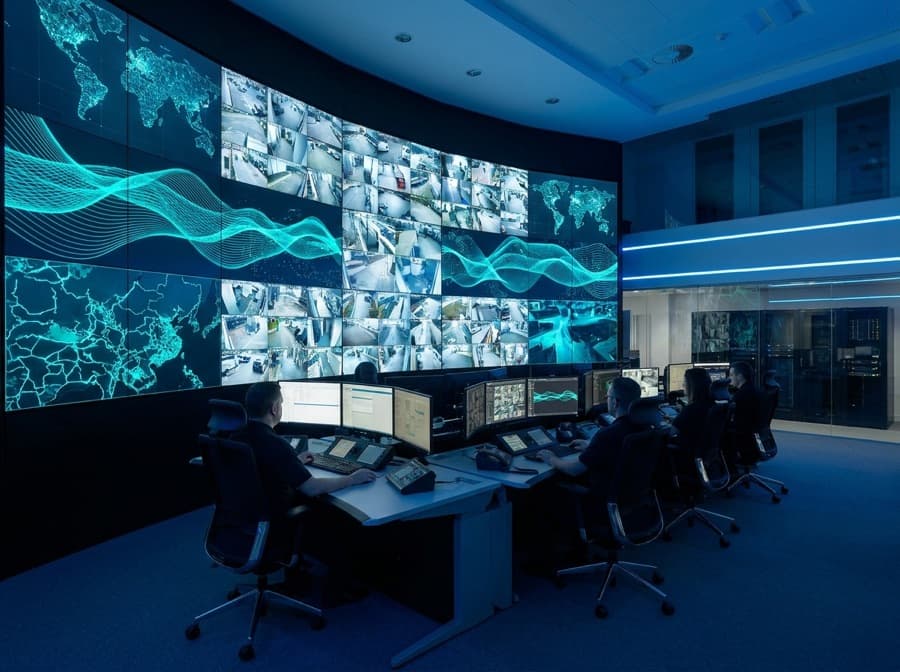
Choose an LCD video wall when people sit close, the content is fine text or data, and the wall is modest in size; choose LED when you need a seamless image, a large or unusual shape, high brightness or a surface that will be filmed. LCD walls are built from flat panels with thin bezels between them, so there is always a visible grid; LED walls are built from modules that join without seams. Neither is “better” in general — each is the right answer for a different room, and many buildings in Nepal end up with both.
What is the actual difference between an LED and an LCD video wall?
An LCD video wall is a grid of individual flat-panel displays mounted edge to edge, while an LED video wall is a single surface made of small modules in which every pixel emits its own light. That construction difference drives almost everything else.
Each LCD panel has a backlight and a liquid-crystal layer behind glass, with a frame around it. Even “ultra-thin bezel” panels leave a seam of roughly 3.5 mm where two panels meet, so a 3×3 LCD wall always shows a faint window-pane grid. An LED wall has no backlight and no frame between modules; once it is calibrated, it reads as one continuous picture.
The practical consequence is that LCD walls come in fixed panel sizes and shapes, while LED walls can be built to almost any width and height in module increments — including curves, corners and very large spans.
When is an LCD video wall the better choice?
LCD is usually the right choice when viewers are close, the content is detail-heavy, and the wall is a few panels in size. A reception wall of 2×2 panels, a small monitoring wall where operators sit two metres away, or a menu and information wall in a corridor are all natural LCD jobs.
LCD panels carry very high pixel density, so small text, spreadsheets and dashboards stay crisp at arm’s length. To get the same sharpness from LED at that distance you need a very fine pixel pitch, and finer pitch costs steeply more. For a small, close-viewed wall, LCD delivers the resolution at a far lower entry point.
LCD is also a sensible choice where content is mostly static and the room is not bright. Our Evolve Signage LCD line carries a one-year warranty and suits receptions, corridors and small meeting rooms well.
When is an LED video wall the better choice?
LED is the better choice whenever the seams would ruin the image, the wall is large, the room is bright, or the screen will be filmed. A lobby feature wall, an auditorium backdrop, a boardroom where a face must not be cut by a bezel, or a broadcast set all fall into this group.
Brightness is a major reason. Indoor LED typically runs 600–1,200 nits and can go much higher, while LCD video wall panels sit around 500–700 nits. In an atrium with daylight from glazing, or a hall with strong stage lighting, LCD looks washed out where LED holds contrast.
LED also scales without penalty. A 6 m wide wall is simply more modules, whereas an LCD wall that size becomes a large grid of seams. For anything beyond a few metres across, LED is usually the only option that looks like one screen.
How do resolution and viewing distance compare?
LCD resolution is fixed per panel, whereas LED resolution depends on pixel pitch and wall size. A rough rule for LED is that pitch in millimetres is about the closest comfortable viewing distance in metres — see our pixel pitch guide for the detail.
This gives a simple test. If your nearest regular viewer is under about 1.5 m away, LED needs a very fine pitch and LCD becomes the economical option. If viewers are 3 m or more away, a moderate LED pitch looks sharp and the seamless image wins. Between the two, the decision rests on content: text and data favour LCD; video, faces and brand imagery favour LED.
A worked example: a 3 m wide LED wall at 2.5 mm pitch is 1,200 pixels across, which is ample for video seen from the back of a meeting room but too coarse for a spreadsheet read from a desk at one metre.
Which lasts longer and copes better with Nepal’s conditions?
Both technologies last for years if they are powered and ventilated properly, but they age differently. LCD panels are typically rated around 50,000 hours and their backlights dim gradually; LED modules have long lives too, and individual modules can be replaced without touching the rest of the wall.
Nepal’s voltage swings and load management affect both equally. Either kind of wall should sit behind proper surge protection and a UPS or stabilised supply sized for its real draw, and both need a clean changeover when a generator kicks in. Dust is the other shared enemy: in the Kathmandu Valley and the Terai, filters and periodic cleaning matter for both.
Weight and mounting differ. LCD panels are heavy glass units that need rigid wall mounts; LED cabinets are lighter per square metre but form larger single structures. In either case the mount must be designed for earthquake loads, not just the static weight.
How do repairs and spares differ?
An LED wall is repaired by swapping a module, while an LCD wall is repaired by swapping a whole panel. That difference matters over a ten-year life.
A failed LED module is a small part that can be exchanged from the front or rear in minutes, and if it comes from the same production batch it matches its neighbours. Our LED displays carry a two-year manufacturer warranty honoured locally, with spares held in Kathmandu, so a failure is a visit rather than a shipment.
A failed LCD panel has to be replaced as a unit, and a new panel bought years later may not match the brightness and colour of its aged neighbours. Buying one or two spare panels at installation is the practical answer for any LCD wall that must stay uniform.
How should you decide for your room?
Decide by answering four questions: how close is the nearest viewer, how bright is the room, how large is the wall, and will it ever be on camera. Close, dim, small and off-camera points to LCD; far, bright, large or filmed points to LED.
Many organisations need both. A bank might put an LED wall in its headquarters lobby and LCD screens in branch queues; a hospital might use LED at the entrance and LCD for wayfinding. Treat the two as tools rather than rivals.
The short version
- LCD video walls always show thin seams between panels; LED walls are seamless.
- LCD suits small, close-viewed walls with text or data; LED suits large, bright or filmed spaces.
- LCD video wall panels run around 500–700 nits; indoor LED typically 600–1,200 nits.
- LED walls are repaired module by module; LCD walls need whole-panel replacement.
- Both need surge protection, stable power and earthquake-rated mounting in Nepal.
- LED displays carry a two-year local warranty; Evolve Signage LCD carries one year.
Common questions
Is an LED video wall better than an LCD video wall?
Neither is better in every case. LED is better for large, bright, seamless or filmed walls, while LCD is better for small walls viewed from close up where fine text matters. The right choice depends on viewing distance, room brightness, wall size and content.
Can you remove the lines between LCD video wall screens?
No. Even ultra-thin bezel LCD panels leave a combined seam of about 3.5 mm where two panels meet. If the image must be completely seamless, an LED wall is the only option.
Which is cheaper, an LED or LCD video wall?
For small walls viewed from close up, LCD is usually the more economical way to get high resolution, because fine-pitch LED costs steeply more. For large walls viewed from a distance, LED often makes more sense because it scales without seams. Our price guide explains what drives LED cost.
Which video wall is best for a control room in Nepal?
It depends on how close operators sit and how large the wall is. Small walls viewed from desks a metre or two away often suit LCD, while larger walls viewed from further back increasingly use fine-pitch or COB LED, which is seamless and can be run at a comfortable brightness of around 600 nits.
How long does an LCD video wall last compared with LED?
LCD panels are typically rated around 50,000 hours, with the backlight dimming gradually over that time. LED walls also have long lives, and failed modules can be swapped individually, which makes it easier to keep the whole surface uniform over many years.
Can an LCD video wall be used outdoors?
Standard LCD video wall panels are designed for indoor use and are not bright or sealed enough for outdoors. Outdoor screens in Nepal should be high-brightness LED with IP65 sealing on both front and rear, or purpose-built outdoor LCD signage in a sealed enclosure.
Where to go next
More in Technology Explained
Want this applied to your site?
We survey the site free, then spec the pitch, brightness and structure around what it actually needs.
Book a site survey