Guides / Specification
Indoor vs outdoor LED in Nepal: brightness, IP rating and the monsoon
8 min read · Updated July 2026
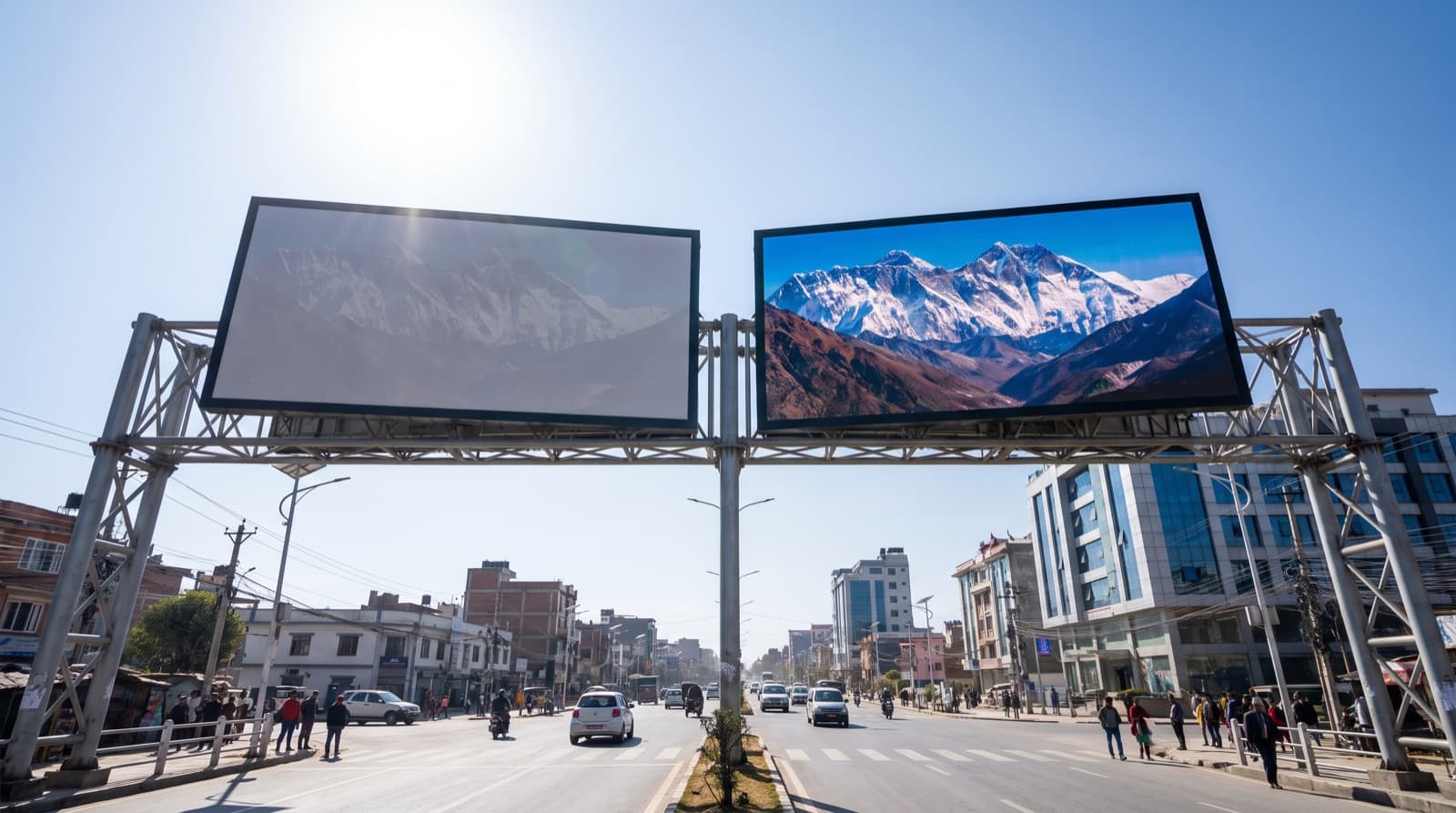
The difference between an indoor and an outdoor LED display is not a category on a price list — it is brightness, sealing and thermal design. Getting it wrong is the most expensive specification error in this market, because it cannot be corrected after installation.
Brightness: the number that decides everything outdoors
Brightness is measured in nits (candela per square metre). An indoor display typically runs 600 to 1,500 nits. An outdoor display facing daylight needs 5,000 to 10,000.
That gap is not a refinement, it is a threshold. Put a 1,000-nit screen outdoors and it does not look slightly dim — it becomes a milky grey rectangle, genuinely unreadable, for the entire part of the day when the sun is on it. Which is, inconveniently, the part of the day with the most traffic past it.
For Nepal specifically, 6,000 nits is a sensible working minimum for any screen facing open daylight, with 8,000 to 10,000 giving real headroom for direct sun on the screen face and for west-facing sites in the afternoon. Kathmandu sits at altitude with strong, clear light for much of the year, which is not a forgiving environment for an underspecified display.
Why indoor screens run dim on purpose
It is worth understanding that indoor brightness is low by design, not by limitation. A 5,000-nit wall in a boardroom would be genuinely unpleasant to sit in front of, and in a control room it would defeat the point entirely — operators work in dim rooms precisely so they can read the screens comfortably for hours.
Nepal's first COB control-room installation was specified at 600 nits for exactly this reason. The engineering question there was not how bright it could be but whether it held its grayscale accurately at low output, which is a much harder thing to deliver.
IP rating, and the detail most quotes leave out
IP65 means dust-tight and protected against water jets from any direction. For outdoor LED in Nepal it is the baseline, not an upgrade.
The detail that matters, and that is frequently glossed over: ask whether the rating applies to the front face only, or to front and rear. Front-only ratings are common and considerably cheaper, and they are not adequate here. Monsoon rain does not fall politely onto the front of a screen — it is driven sideways by wind and thrown upward off the road surface, and it reaches the back of a cabinet as readily as the front.
What actually fails in a poorly sealed outdoor display is almost never the LEDs. It is corrosion at the connectors behind them, which starts quietly, is invisible until it isn't, and typically shows up as intermittent faults a season or two after installation.
Dust, and why it is a year-round problem
Nepal's dry season brings sustained airborne dust, particularly in the Kathmandu valley. Dust ingress into a cabinet insulates components that were designed to shed heat, and heat is the primary driver of LED degradation. A display running hotter than designed simply ages faster.
This is one of the practical reasons COB performs well in dusty environments even indoors: with the diodes sealed under resin, there is no package geometry for dust to settle into on the display face itself.
Running cost, which is an outdoor problem specifically
A large outdoor screen at full brightness around the clock draws real power, and at Nepali tariffs that becomes a significant operating line rather than a rounding error. Outdoor sites are routinely modelled on expected media revenue with no realistic figure for electricity, and the economics only become visible a year in.
Two settings do most of the work. An ambient light sensor continuously matches output to conditions, so the screen is bright at midday and considerably dimmer at night — which protects both the bill and your relationship with everyone living opposite it. Scheduled on/off shuts the screen down in hours when nobody is watching. Both should be configured at commissioning rather than left at defaults.
It is also worth knowing that real-world consumption sits well below the peak rating, because peak assumes a full-white screen and real content is mostly mid-tones. A public information display running sixteen hours a day, as at Tokha Municipality Ward 5, draws far less than its nameplate figure suggests.
Semi-outdoor: the case that catches people out
Covered forecourts, deep shop awnings, stadium concourses and window displays behind glass are neither fully indoor nor fully outdoor, and they are where specifications go wrong most often.
The test is not whether rain reaches the screen — it is how much light does. A display behind south-facing glass is, optically, an outdoor screen and needs outdoor brightness, even though it will never get wet. Conversely, a screen under a deep permanent canopy may need outdoor sealing for the humidity while running at moderate brightness. Judge the two requirements separately.
The short version
- Indoor displays run 600–1,500 nits; outdoor displays facing daylight need 5,000–10,000.
- Under-specified brightness is unfixable after installation — the screen is simply unreadable in daylight.
- IP65 must apply front and rear. Front-only ratings are common and inadequate for monsoon rain.
- What fails in a badly sealed outdoor screen is corrosion at the connectors, not the LEDs.
- Ambient dimming and scheduled shutdown are the two settings that control outdoor running cost.
- Behind glass in strong daylight, specify outdoor brightness even though the screen never gets wet.
Common questions
Can I use an indoor LED display outdoors under a cover?
Generally no. Even fully shaded, ambient daylight levels outdoors far exceed indoor levels, and humidity will reach an unsealed cabinet. Judge brightness by the light reaching the screen and sealing by the moisture reaching it — they are separate questions.
How many nits do I need for an outdoor screen in Nepal?
6,000 nits is a realistic minimum for daylight-facing sites; 8,000–10,000 gives headroom for direct sun and west-facing positions. Auto-dimming should then reduce output substantially after dark.
What does IP65 mean?
The first digit, 6, means dust-tight. The second, 5, means protected against water jets from any direction. For Nepal, confirm the rating covers both the front and the rear of the cabinet.
Will an outdoor screen survive the monsoon?
Yes, if specified for it: IP65 front and rear, UV-stable gaskets that do not harden and crack, and designed drainage paths so water that enters can leave. Installations delivered to this standard have run without maintenance issues through multiple monsoons.
Does an outdoor display need extra structural work?
Almost always. An outdoor screen is a structural project as much as a display one — wind loading, foundations, mounting steel and electrical supply all have to be engineered alongside the panels rather than after them.
How much does an outdoor LED display cost to run?
It depends on size, brightness and content, but real consumption is well below the peak rating because content is rarely full white. Ambient dimming and scheduled overnight shutdown make the largest difference and should be set at commissioning.
Where to go next
Want this applied to your site?
We survey the site free, then spec the pitch, brightness and structure around what it actually needs.
Book a site survey