How it connects
source
Source (PC / player / camera)
processor
NovaStar processor
controller
Sending & receiving cards
wall
LED wall
The challenge
What usually goes wrong on this kind of project, and why it is worth specifying around.
A screen that blacks out your own window
A solid wall trades your daylight and your interior for the advertising.
A conventional LED wall behind glass is a solid panel. It sells to the street and takes the daylight, the depth and the view of your own merchandise away from everyone inside. For a shop whose interior is part of the brand, that trade is usually a bad one — and it is only discovered after installation.
Brand colours the screen cannot actually hit
Roughly-right red won't match the product standing beside it.
Retail brands are built on precise colour. A display with a narrow gamut or sloppy calibration renders a specific red as roughly-red, and it will not match the same red on the product, the packaging or the printed campaign standing beside it. In a luxury context that inconsistency reads as cheapness before anyone can articulate why.
Daylight on the glass
Mall-brightness behind glass is dead during peak footfall.
A shopfront faces the street, and for much of the day the sun faces it back. Screens specified for indoor mall brightness wash out completely behind glass in direct light, which means the window is dead during exactly the hours with the most footfall past it.
Content that quietly stops changing
A static screen signals a business that stopped paying attention.
The screen goes in, the launch campaign plays, and eighteen months later it is still playing. Without a scheduling system that someone non-technical can actually operate, a display becomes a fixture people stop noticing — and a static screen is worse than no screen, because it signals a business that has stopped paying attention.
How we specify around it
The decisions that separate a display that still works in year three from one that merely looked good on the quote.
Transparent LED at 60–90% transmittance
Keep the window and gain the screen.
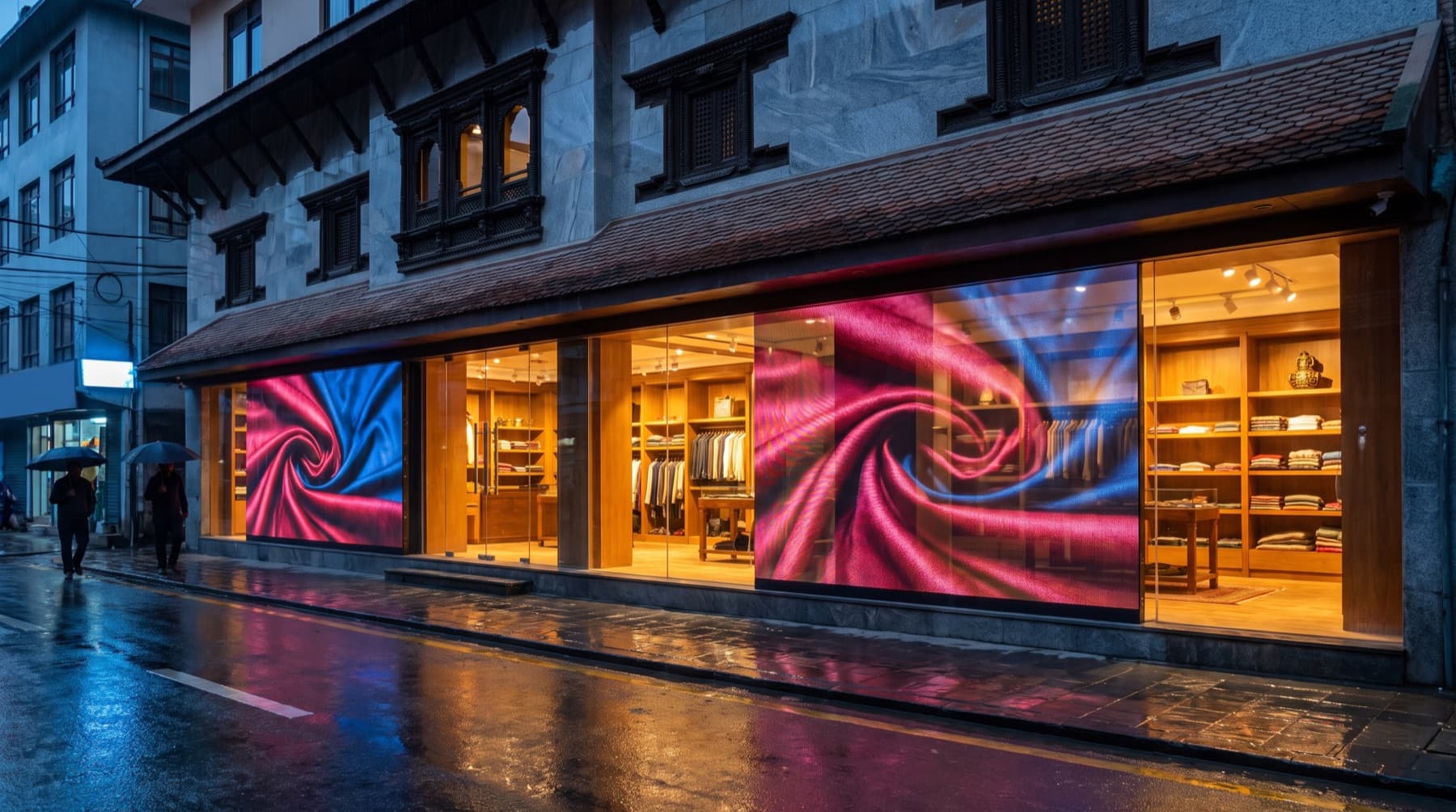
A transparent film or strip display carries bright content on the glass while daylight and sightlines pass through it. Shoppers outside see the campaign, customers inside still see the street and the light still reaches the shop floor. You keep the window and gain the screen instead of trading one for the other.
Wide gamut with point-by-point calibration
Your brand colour, consistent across the whole surface.
Calibrated panels hold your brand colours accurately and consistently across the whole surface, so what is on screen matches the product beside it and the campaign in print. On a wall of any size, uniformity is what separates premium from ordinary.
Brightness matched to where it faces
Punches through daylight outside, restrained indoors.
Shopfront-facing displays are specified to punch through daylight on glass; interior signage is specified far lower so it reads as considered rather than glaring. Both dim automatically as ambient light drops, which is what stops an evening storefront looking like a floodlight.
Scheduling anyone on the team can run
Updating the window stops requiring a technician.
Cloud scheduling lets content change by daypart, by day of week or by campaign, across one screen or every store, from a browser. The point is not the technology — it is that updating the window stops requiring a technician and therefore actually happens.

Reference installations worldwide
Doha Oasis
Qatar
107 m² Upanel 1.2 curved display.
Best value in Nepal
Lampro
sister brand to Unilumin · best value in Nepal · COB · DOOH · rental
View Lampro →Where it's used


How we scope and deliver it
Seven stages, all handled by our own team. Nothing is subcontracted, which is why we can commit to the timeline at the point of quoting.
- 01
Site assessment
We come to the site and measure it — viewing distances, ambient light, sightlines, wall or ground conditions, and where the power and data will run. Free, and it is what makes the rest of the quote real rather than estimated.
- 02
Structural design
Mounting is engineered alongside the display, not after it. Steel structures are fabricated to suit the site, which for outdoor work means wind loading and foundations as much as the screen itself.
- 03
Specification & quotation
Pitch, size, brightness and IP rating chosen for how the screen will actually be used, then quoted as a complete system — panels, processing, structure, cabling and commissioning — so nothing surfaces later as an extra.
- 04
Supply
Genuine Unilumin product with CE and RoHS certification and full manufacturer authorisation — the documentation set government tenders require, which we hold from previous work.
- 05
Installation
Our own technical team, never subcontracted. A standard indoor or outdoor install between 2×1.5 m and 4×2.5 m takes two to three days including the mounting structure; spans over 6 m or awkward mounting typically run five to seven.
- 06
Commissioning & CMS
Point-by-point calibration, brightness and scheduling configured for the site, and the content management system set up so your team can change what plays without calling anyone.
- 07
Training & support
We train your staff on the system before we leave, then back it with a two-year warranty and spare modules held in Kathmandu — so a fault is a visit, not an import.
FAQ
How does transparent LED actually work?
The pixels sit on narrow strips with clear gaps between them, so the panel is mostly open area. From the street the lit content dominates; from inside, the eye reads through the gaps to the daylight beyond. Transmittance between 60% and 90% is the range worth considering.
Will a window screen be visible in daylight?
Only if it is specified for it. A shopfront in direct sun needs considerably more brightness than an interior display — this is the most common specification mistake in retail, and it cannot be corrected after installation.
What pitch for in-store signage?
Customers stand within two or three metres, so P1.5–P2.6 is typical. Coarser pitch saves money but becomes visible as a dot structure at that distance, which undermines exactly the premium impression the screen was bought to create.
Can we manage several stores from one place?
Yes — cloud scheduling handles multiple sites from a single browser login, with content set per store or pushed to all of them. It is the difference between a network of screens and a collection of them.
Does it run all day, and what does that cost?
Retail displays typically run store hours with automatic dimming as daylight changes, which cuts consumption substantially against the peak figure. Scheduled off-hours shutdown is worth configuring at commissioning.
Transparent LED or a conventional wall behind the glass?
If the interior matters — daylight, sightlines, visible merchandise — transparent is usually right. If the window is purely an advertising surface and the interior behind it is not part of the experience, a conventional wall gives you more brightness and contrast for the money.
Talk to an expert about retail & luxury storefronts
Tell us the site and the size — we survey, spec and quote it.