How it connects
source
Source (PC / player / camera)
processor
NovaStar processor
controller
Sending & receiving cards
wall
LED wall
The challenge
What usually goes wrong on this kind of project, and why it is worth specifying around.
Moiré: the screen fights the camera sensor
Two grids interfere, and no colour grade removes it.
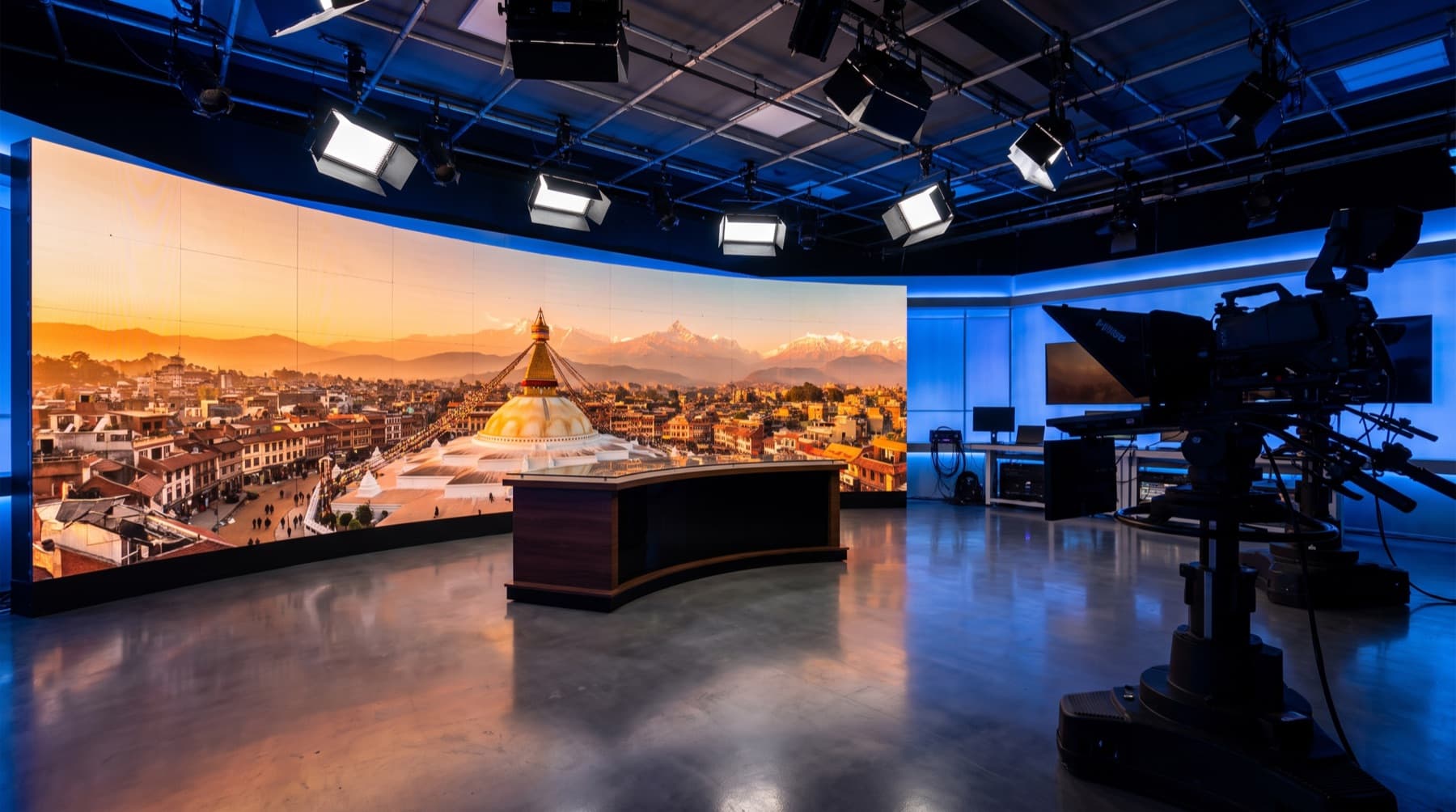
A camera sensor is a grid of photosites and an LED wall is a grid of pixels. Point one at the other and the two grids interfere, producing shimmering patterns across the shot that no colour grade removes. It appears and disappears as the camera moves or zooms, which makes it worse — you cannot simply frame around it.
Scan lines from insufficient refresh
The camera catches the wall mid-redraw. Live, there's no second take.
The wall redraws itself faster than the eye can follow but not necessarily faster than the shutter. Below the threshold, the camera captures the wall mid-refresh and records horizontal bands rolling through frame. On a live broadcast there is no second take.
Latency between the tracking system and the wall
The background lags the camera and the illusion collapses.
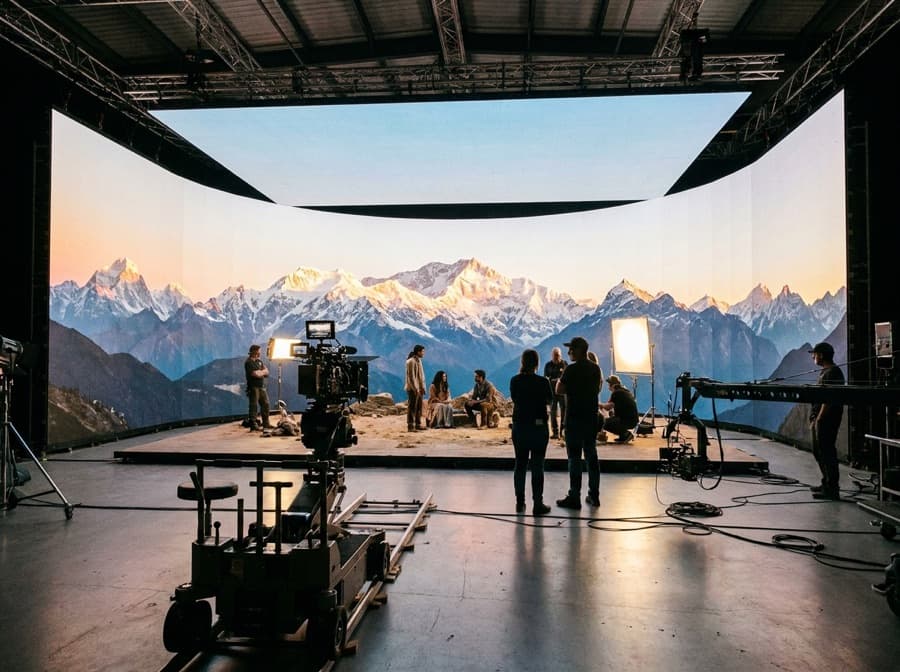
In virtual production the background must move in step with the camera. Any delay in the chain shows up as the background lagging the camera move, and the illusion collapses — the talent stops looking like they are standing in the scene and starts looking like they are standing in front of a screen.
Colour that does not match the rest of the shoot
The wall lights the talent, so a cast has to be fixed on every shot.
The wall is a light source in the scene as well as an image. If its colour space and gamma do not line up with the camera's profile, everything lit by it — faces especially — picks up a cast that has to be fixed in post on every single shot.
How we specify around it
The decisions that separate a display that still works in year three from one that merely looked good on the quote.
Anti-moiré panel construction
Built into the panel — not a setting you can enable later.
Black-face masking and considered pixel geometry break up the regular grid that interferes with the sensor, so the wall holds up under camera movement and zoom rather than only at one framing. This is a physical property of how the panel is built, not a setting you can enable later.
3,840 Hz and above, with genlock
The wall is never captured mid-refresh.
High refresh eliminates banding at normal shutter angles, and genlock ties the wall's refresh to the camera and the facility clock so the two stay in step through the whole shoot. Together they are what make the wall filmable rather than merely visible.
Sub-frame processing latency
Parallax reads correctly on a moving shot.
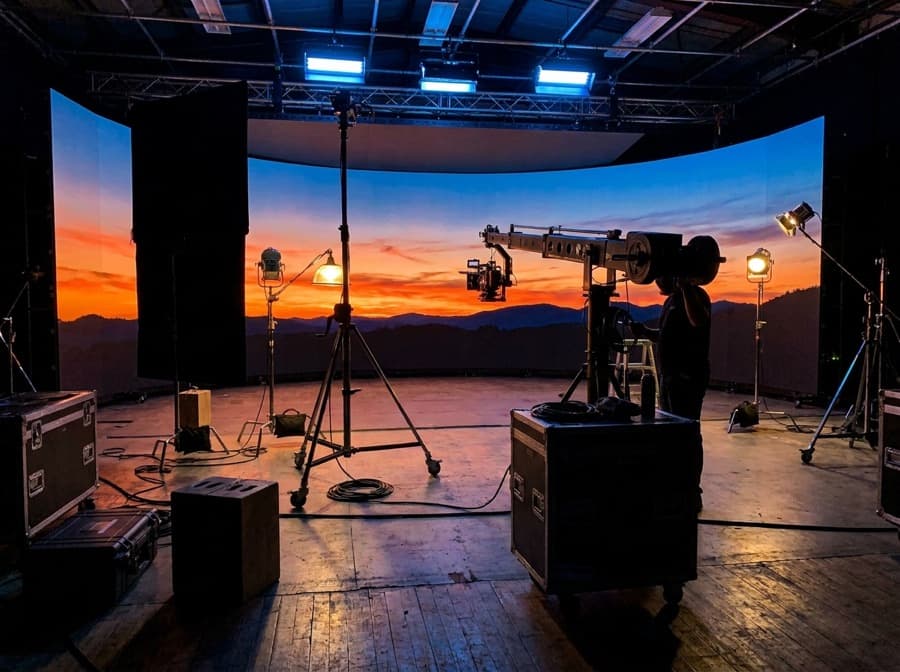
Low-latency processing keeps the rendered background aligned with the tracked camera position, so parallax reads correctly and the set holds together on a moving shot. This is the difference between a virtual production volume and an expensive backdrop.
Calibrated colour space and gamma
Saves more time in post than it costs to set up.
The wall is profiled to a known standard and matched to the camera, so the light it throws onto the talent is correct in-camera and the background needs no per-shot correction. It saves more time in post than it costs to set up.
Reference installations worldwide
BBC Sport UEFA 2024
Berlin
Open-air studio, Brandenburg Gate.
Netflix "Berlin"
Series
ROE virtual-production volume.
League of Legends Worlds
Shanghai
ROE xR esports stage.
Recommended brands
Best value in Nepal
Lampro
sister brand to Unilumin · best value in Nepal · COB · DOOH · rental
View Lampro →Where it's used
How we scope and deliver it
Seven stages, all handled by our own team. Nothing is subcontracted, which is why we can commit to the timeline at the point of quoting.
- 01
Site assessment
We come to the site and measure it — viewing distances, ambient light, sightlines, wall or ground conditions, and where the power and data will run. Free, and it is what makes the rest of the quote real rather than estimated.
- 02
Structural design
Mounting is engineered alongside the display, not after it. Steel structures are fabricated to suit the site, which for outdoor work means wind loading and foundations as much as the screen itself.
- 03
Specification & quotation
Pitch, size, brightness and IP rating chosen for how the screen will actually be used, then quoted as a complete system — panels, processing, structure, cabling and commissioning — so nothing surfaces later as an extra.
- 04
Supply
Genuine Unilumin product with CE and RoHS certification and full manufacturer authorisation — the documentation set government tenders require, which we hold from previous work.
- 05
Installation
Our own technical team, never subcontracted. A standard indoor or outdoor install between 2×1.5 m and 4×2.5 m takes two to three days including the mounting structure; spans over 6 m or awkward mounting typically run five to seven.
- 06
Commissioning & CMS
Point-by-point calibration, brightness and scheduling configured for the site, and the content management system set up so your team can change what plays without calling anyone.
- 07
Training & support
We train your staff on the system before we leave, then back it with a two-year warranty and spare modules held in Kathmandu — so a fault is a visit, not an import.
FAQ
What actually causes moiré and can it be fixed in post?
It is interference between the camera's sensor grid and the wall's pixel grid, and no, it cannot be reliably fixed afterwards. It is prevented by panel construction, adequate camera-to-wall distance, and sometimes a slight defocus of the background — which is why panel choice matters before the shoot, not during it.
What refresh rate is genuinely necessary?
3,840 Hz is the practical minimum for broadcast. Higher-end virtual production work pushes beyond it, particularly where high-speed or slow-motion capture is involved, since the faster shutter samples the wall more aggressively.
How close can the camera get to the wall?
Finer pitch allows closer framing before the pixel structure becomes visible. For tight shots against the wall, P1.5 or finer is typical; a background that only ever appears in wide shots can be considerably coarser and much cheaper.
Do we need an LED ceiling as well as a wall?
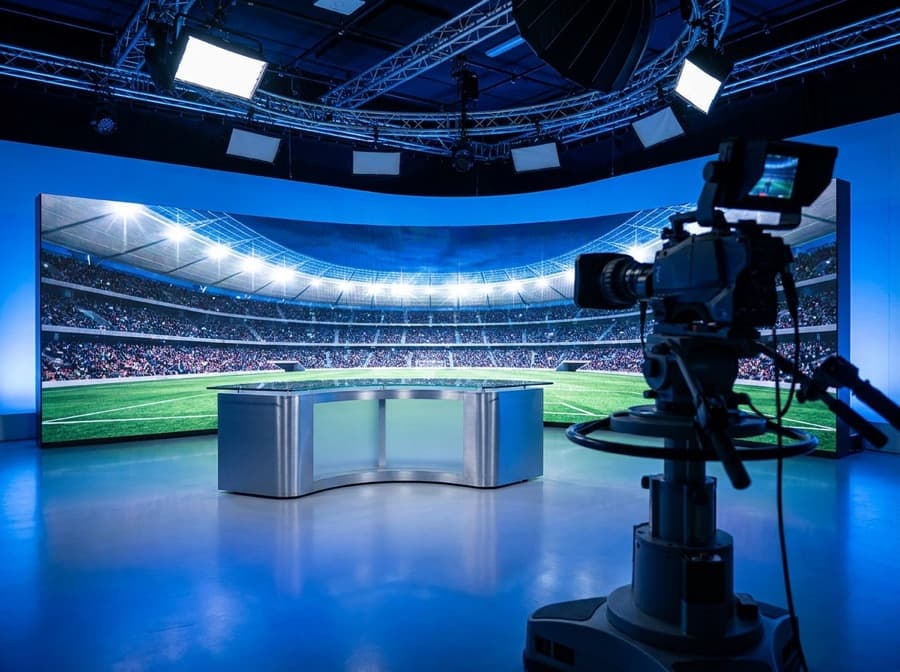
For in-camera VFX it is usually worth it, because the ceiling provides the overhead light that sells the illusion on reflective surfaces and faces. For a virtual news set, a wall alone is normally sufficient.
Can a broadcast wall also be used for live events?
Yes, and it will considerably outperform standard rental stock on camera. The constraint is usually mounting and handling — broadcast panels are specified for fixed install and are not built for repeated road use.
What does genlock do?
It synchronises the wall's refresh cycle to the same reference clock as your cameras, so the wall is never captured mid-redraw. Without it, banding can appear intermittently even on a panel with an adequate refresh rate.
Talk to an expert about broadcast studios & virtual production
Tell us the site and the size — we survey, spec and quote it.