How it connects
source
Source (PC / player / camera)
processor
NovaStar processor
controller
Sending & receiving cards
wall
LED wall
The challenge
What usually goes wrong on this kind of project, and why it is worth specifying around.
Seams you stop being able to ignore
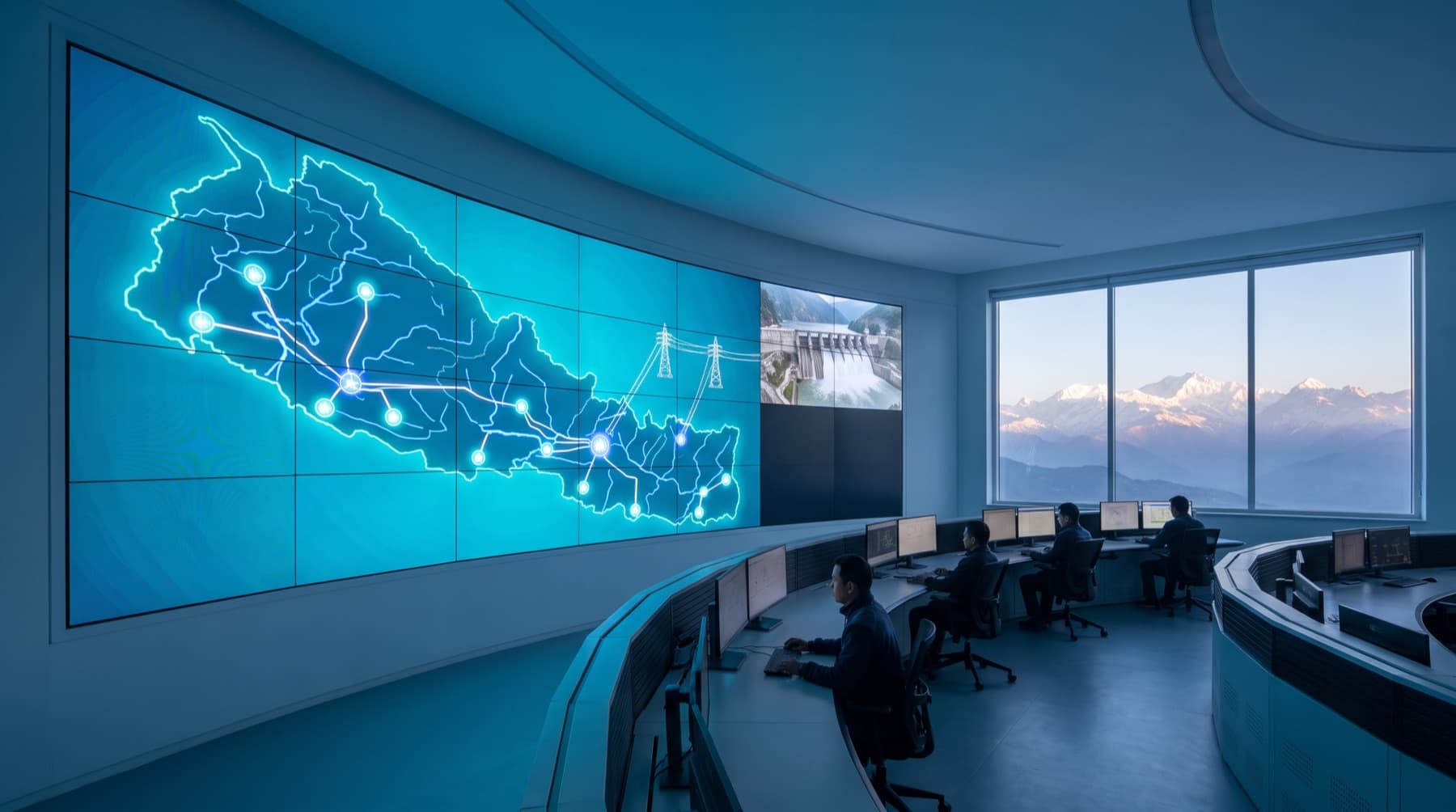
LCD bezels cut straight through the map an operator is reading. LED has none.
A wall built from LCD panels always has a bezel line, however thin the spec sheet claims. On a dispatch map or a pipeline schematic those lines cut straight through the thing an operator is trying to read, and after ten hours the eye keeps snagging on them. LED has no bezel at all — the cabinets butt together and the image is continuous across the whole canvas.
Differential ageing on a wall that never turns off
A static layout burns its own shape into a cheap wall within three years.
A control room runs the same layout for years — the same map in the same corner, the same alarm strip along the bottom. Panels that are cheap on brightness uniformity age unevenly under that load, and within two or three years you can see the old layout ghosted into the wall even when the content changes. Point-by-point calibration and quality binning are what prevent it, and they are exactly what gets cut to hit a low price.
Grayscale collapsing in a dim room
Run a cheap driver at 15% brightness and shadow detail simply disappears.
Control rooms are deliberately kept dark so operators can see the screens, which means the wall runs at low brightness. Cheap drivers lose their grayscale steps down there — dark greys crush to black, gradients band, and detail in a night-time camera feed simply disappears. A 14-bit driver is not the same as a 16-bit driver once you are running at 15% brightness.
Downtime when a single module fails
Rear-only access turns a ten-minute swap into a planned outage.
If a wall can only be serviced from behind, replacing one failed module means a maintenance corridor behind the wall or dismantling the front. In a room that is not allowed to go dark, that is the difference between a ten-minute swap and a planned outage — and it is decided at the design stage, not when the module fails.
How we specify around it
The decisions that separate a display that still works in year three from one that merely looked good on the quote.
N+1 redundancy on both power and signal
A failure degrades the wall instead of dropping it.
Dual power supplies per cabinet and hot-backup sending cards mean a single failure degrades the wall rather than dropping it. The backup card carries the signal the instant the primary stops responding, with no operator intervention. For a room whose whole purpose is to still be working during an incident, this is not an upgrade — it is the specification.
16-bit grayscale, tuned for low brightness
Shadow detail survives when the wall is running dim.
High bit-depth processing keeps the tonal steps intact when the wall is running dim, so shadow detail in a CCTV feed stays legible and gradients stay smooth. Combined with COB's low surface reflectance, the wall keeps contrast in a room with lights on behind the operators.
Flip-chip COB, not exposed lamps
Nothing protrudes, so nothing gets knocked off.
COB encapsulates the diodes under a hardened resin surface rather than leaving them proud of the board. Nothing catches on a sleeve or a trolley, cleaning is a wipe rather than a risk, and the failure mode that plagues fine-pitch SMD walls — a knocked-off lamp leaving a dead pixel — largely disappears. It matters more the finer the pitch gets.
Front-serviceable cabinets
Modules pull from the operator side — no rear corridor needed.
Magnetic front access means a module is pulled and replaced from the operator side in minutes, with no rear corridor and no structural allowance for one. That reclaims usable floor area in the room and turns most faults into a task rather than an event.
Reference installations worldwide
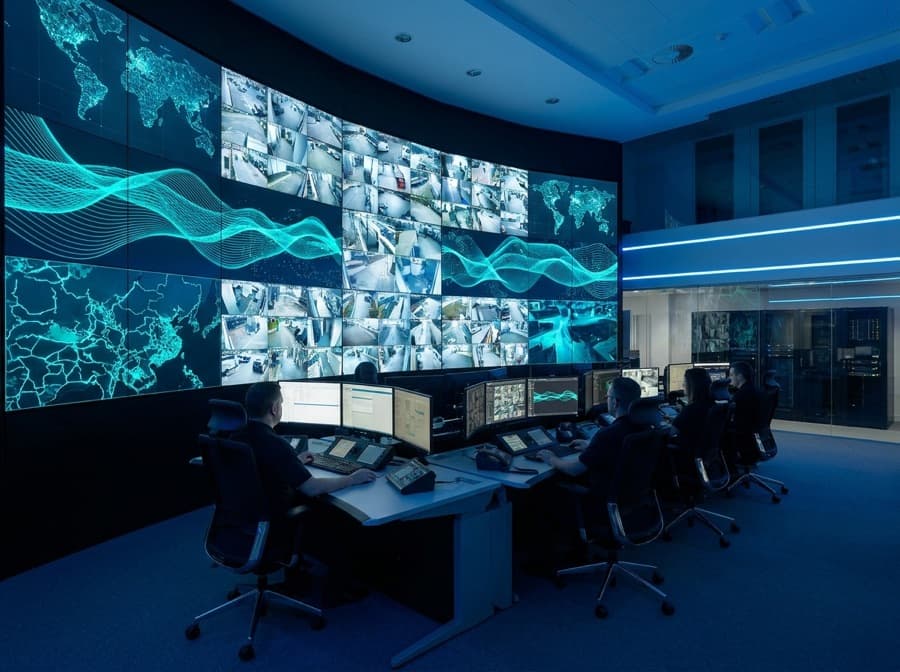
Aramco Hawiyah
Saudi Arabia
7.2 × 2 m UMini W1.2 fine-pitch — mission-critical monitoring.
JANAF
Croatia
Upanel 1.5 oil-pipeline control room.
Mabes Polri (Police HQ)
Indonesia
UpanelS 1.9 command centre.
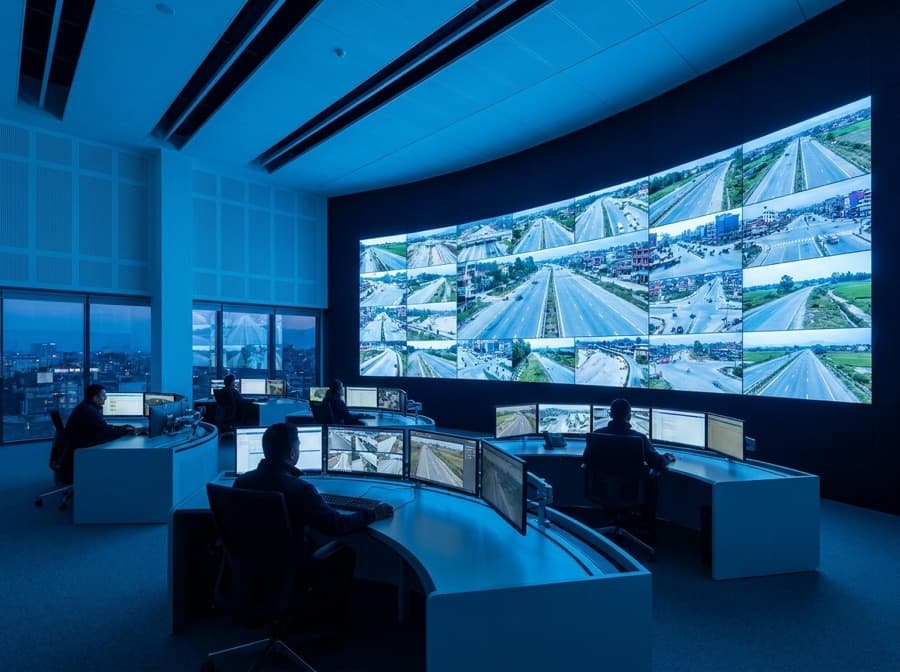
PLUS Expressway
Malaysia
17 m² UTWII 1.5 highway monitoring.
Best value in Nepal
Lampro
sister brand to Unilumin · best value in Nepal · COB · DOOH · rental
View Lampro →Control system
NovaStar MX-series + VMP, redundant sending cards, remote monitoring
NovaStar control →Where it's used
How we scope and deliver it
Seven stages, all handled by our own team. Nothing is subcontracted, which is why we can commit to the timeline at the point of quoting.
- 01
Site assessment
We come to the site and measure it — viewing distances, ambient light, sightlines, wall or ground conditions, and where the power and data will run. Free, and it is what makes the rest of the quote real rather than estimated.
- 02
Structural design
Mounting is engineered alongside the display, not after it. Steel structures are fabricated to suit the site, which for outdoor work means wind loading and foundations as much as the screen itself.
- 03
Specification & quotation
Pitch, size, brightness and IP rating chosen for how the screen will actually be used, then quoted as a complete system — panels, processing, structure, cabling and commissioning — so nothing surfaces later as an extra.
- 04
Supply
Genuine Unilumin product with CE and RoHS certification and full manufacturer authorisation — the documentation set government tenders require, which we hold from previous work.
- 05
Installation
Our own technical team, never subcontracted. A standard indoor or outdoor install between 2×1.5 m and 4×2.5 m takes two to three days including the mounting structure; spans over 6 m or awkward mounting typically run five to seven.
- 06
Commissioning & CMS
Point-by-point calibration, brightness and scheduling configured for the site, and the content management system set up so your team can change what plays without calling anyone.
- 07
Training & support
We train your staff on the system before we leave, then back it with a two-year warranty and spare modules held in Kathmandu — so a fault is a visit, not an import.
FAQ
Which pixel pitch should a control room use?
As a rule of thumb the pitch in millimetres is roughly the closest comfortable viewing distance in metres. Operators sit 1–2 m from the wall, so P0.9–P1.5 is the working range. Going finer than the room needs mostly spends money you could put into redundancy and calibration.
Why COB rather than SMD at fine pitch?
Below about P1.5 the individual SMD lamps get small and fragile enough that physical knocks become the main failure mode. COB seals them under a resin layer, which also cuts surface reflection and raises contrast in a lit room. Above P2 the argument weakens considerably.
Does an LED wall suffer burn-in like a plasma or LCD?
Not burn-in in the plasma sense, but LEDs do age with use, so a static layout driven hard for years can leave a faint uneven brightness pattern. Point-by-point calibration at commissioning and periodic recalibration are what keep a wall uniform over its life.
What happens if a power supply or sending card fails mid-shift?
With N+1 configured, the backup takes over automatically and the wall stays up — you get an alert rather than an outage. Without it, you lose the cabinets fed by that supply until someone swaps it.
How much power does a control-room wall draw?
Fine-pitch indoor walls are modest — typically well under half the peak figure in normal use, because control-room content is rarely full-white. The more important electrical question is stable, clean supply and correctly sized circuits, which the site survey covers.
Can we drive it from our existing SCADA and CCTV systems?
Yes. The processor takes the sources you already have and lays them out as windows on the canvas, so the wall becomes another display surface rather than a system your operators have to learn separately.
Talk to an expert about mission-critical control rooms
Tell us the site and the size — we survey, spec and quote it.