Guides / Buying
LED display buying guide for Nepal
9 min read · Updated July 2026
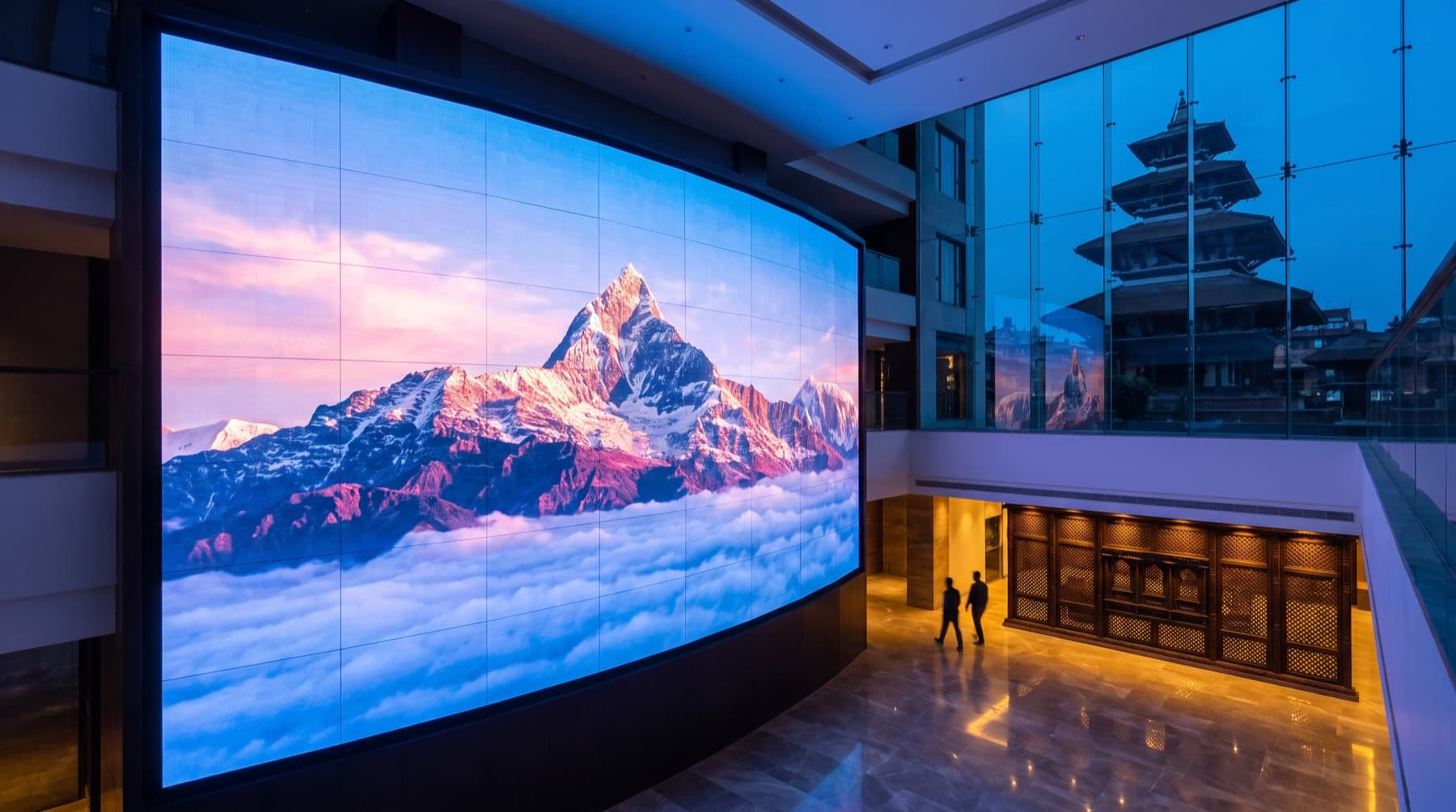
Most LED display problems are decided before anything is ordered. This guide covers the questions that actually determine the specification, what a complete quotation should contain, and how to tell a supplier who has thought about your site from one who is quoting panels.
Start with the room, not the panel
Almost every specification follows from three measurements: how far away the nearest regular viewer stands, how much light falls on the screen, and how big the surface can physically be.
Viewing distance sets the pixel pitch — the pitch in millimetres is roughly the closest comfortable viewing distance in metres. Ambient light sets the brightness, and the gap between an indoor and an outdoor requirement is a threshold rather than a preference. Available surface sets the physical size, which then determines the resolution the content has to supply.
Everything else is a refinement of these three. A supplier who asks about them before quoting is doing the job; one who leads with a model number is selling stock.
The eight questions worth answering before you ask for a quote
Where will people stand? This sets pitch, and it is the closest regular position that matters, not the average.
How much daylight reaches the screen? Indoor, outdoor, or behind glass — and if behind glass, treat it as outdoor for brightness.
Will a camera ever film it? If yes, refresh rate becomes a hard requirement rather than a nicety. Below roughly 3,840 Hz, cameras record banding the eye never sees.
How many hours a day will it run? This drives thermal design, expected service life and, outdoors, the running-cost model.
What is it mounted on? Wall, steel structure, ground support or suspended — and can that structure take the load, including wind loading outdoors.
Who will change the content, and how often? This decides whether you need a cloud CMS or a laptop and an HDMI cable, and it is the question most often skipped.
What happens when a module fails? Front-serviceable or rear access changes the structural design and the size of the room you need behind the wall.
Is this a tender? If so, the documentation set — manufacturer authorisation, CE and RoHS certificates, work completion certificates — matters as much as the specification.
What a complete quotation includes
A display is a system, and a quote for panels alone is not a quote for a working installation. At minimum, expect to see the LED panels, the processing and control equipment, sending and receiving cards, the mounting structure, power distribution and cabling, installation labour, commissioning and calibration, and content management setup.
The items most often left off — and later invoiced as extras — are structure, power work and commissioning. On outdoor projects, structure alone can be a substantial line. Ask explicitly whether the quotation is for a complete working installation or for supply only.
Warranty terms and what happens afterwards belong in the same conversation. A two-year manufacturer warranty honoured locally, with spare modules held in-country, is a materially different proposition from a warranty you would have to claim against an overseas factory.
Buying direct versus buying locally
Importing directly from a factory is genuinely cheaper on paper, and for a well-resourced buyer with technical staff it can be the right decision. It is worth being clear-eyed about what changes.
When a module fails on a directly imported screen, the replacement is a customs clearance and a shipping timeline, during which the wall is dark. Warranty claims are made to a factory in another jurisdiction and another timezone. Commissioning, calibration and structural design become your responsibility, as does any dispute about whether a fault is manufacturing or installation.
The local proposition is not really about the panels — the hardware is the same hardware. It is about who surveys the site, who engineers the structure, who is accountable when something does not work, and how long a fault takes to fix. Judge suppliers on those, because that is what actually differs.
Questions worth asking any supplier
Does the IP rating cover the rear of the cabinet as well as the front? Front-only ratings are common and inadequate outdoors.
What refresh rate, and is it adequate if this is ever filmed?
Is the panel front-serviceable, and what does servicing require in terms of access?
Are spare modules held in Nepal, and are they batch-matched to what is being installed?
Who performs the installation — your own team, or a subcontractor?
What is the realistic timeline from survey to switch-on, and what drives the variation?
Is the quotation for a complete installation or for supply only?
Realistic timelines
For a standard indoor or outdoor installation between roughly 2 × 1.5 m and 4 × 2.5 m, expect two to three days on site including the mounting structure, panel fitting and commissioning.
Larger spans over about six metres, or sites with awkward mounting conditions, typically run five to seven days on site.
Total project time from first survey to switch-on is longer than the install itself, since it includes structural fabrication and equipment supply. A school entrance display delivered to meet an academic calendar was completed end to end inside three weeks, which is a reasonable benchmark for a straightforward outdoor project.
The short version
- Three measurements drive most of the specification: viewing distance, ambient light, available surface.
- Pitch follows viewing distance; brightness follows ambient light. Neither is a matter of preference.
- A quote for panels is not a quote for a working display — check for structure, power, commissioning and CMS.
- Confirm the IP rating covers front and rear, and ask whether spares are held in Nepal.
- Standard installs take 2–3 days on site; spans over 6 m typically take 5–7.
- The real difference between local and direct supply is accountability and downtime, not the hardware.
Common questions
What is the first thing to decide when buying an LED display?
Where people will stand. Viewing distance sets the pixel pitch, and pitch is the single largest driver of both cost and whether the display looks right in the space.
Should I import an LED display directly from China?
It is cheaper on paper. The trade is downtime and accountability — a failed module becomes a customs clearance, and warranty claims go to an overseas factory. If you have technical staff and can tolerate a dark wall for weeks, it can work.
How long does installation take in Nepal?
A standard installation between about 2 × 1.5 m and 4 × 2.5 m takes two to three days on site including the mounting structure. Spans over six metres or complex mounting typically take five to seven days.
What documentation do government tenders require?
Typically manufacturer authorisation, CE and RoHS certification, and work completion certificates from comparable previous projects. Confirm your supplier holds all three before bidding.
What warranty should I expect?
Two years is the standard manufacturer warranty on displays supplied here. What matters more is whether it is honoured locally and whether spare modules are held in Nepal — otherwise a claim means shipping and customs.
Do I need a site survey before a quote?
For anything beyond a small standard indoor screen, yes. Without measuring viewing distances, ambient light, mounting conditions and power access, a quotation is an estimate rather than a price.
Where to go next
Want this applied to your site?
We survey the site free, then spec the pitch, brightness and structure around what it actually needs.
Book a site survey