Guides / Buying & Budget
How to choose the right LED screen size for your room
7 min read · Updated October 2026
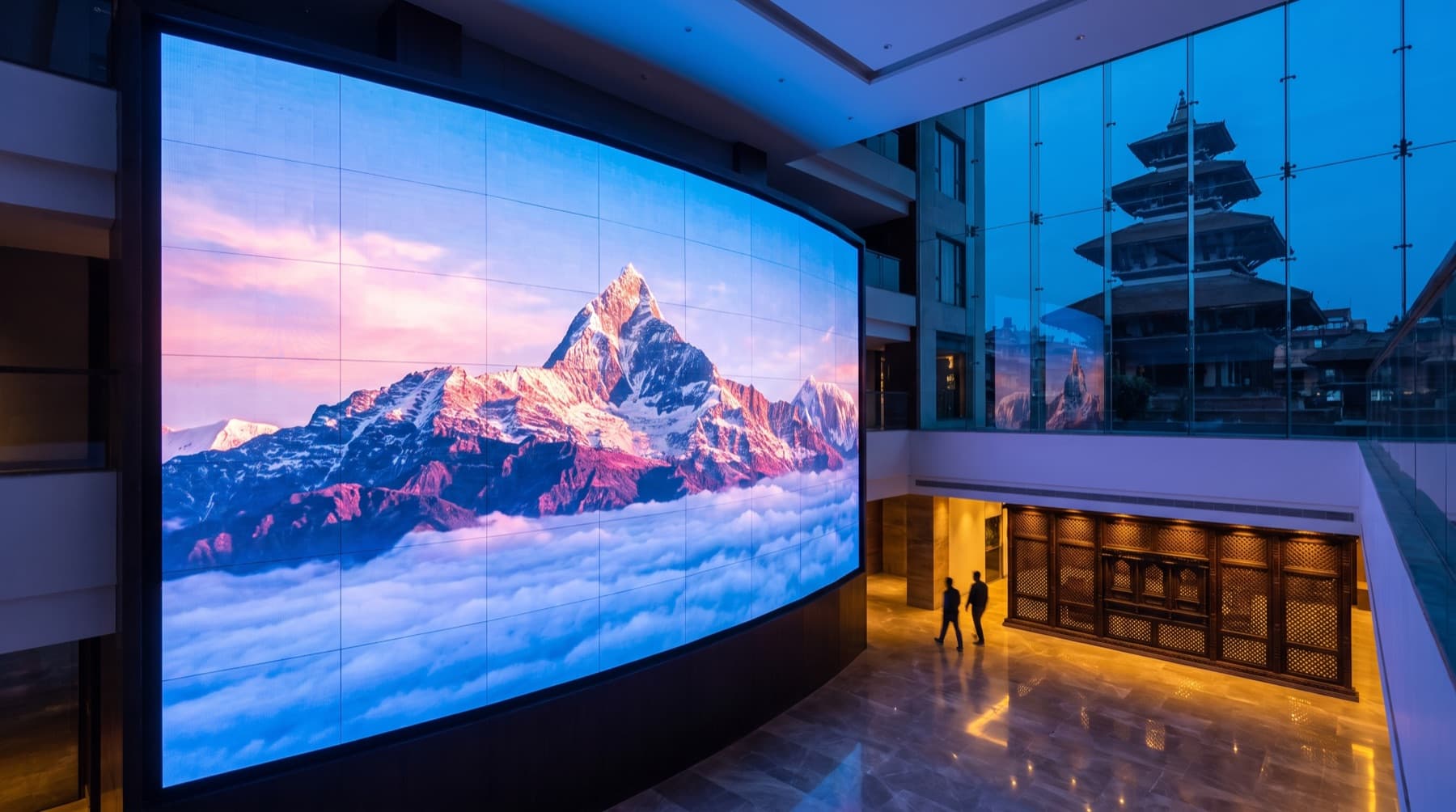
The right LED screen size is set by the farthest person who needs to read it, not by the wall you happen to have. As a working rule, make the screen tall enough that its height is roughly one-sixth of the distance to the back row for video and general content, and closer to one-quarter if people must read small text or detailed data. Then fit that size to the cabinet grid, the pixel pitch and a sensible aspect ratio — in that order.
Where do you start: the wall or the audience?
Start with the audience, because a screen that fills a wall but cannot be read from the back has failed at its only job. Measure the distance from the screen position to the farthest seat or standing point that matters, and the distance to the nearest regular viewer. The far distance sets the minimum height; the near distance sets the pixel pitch.
Only then look at the wall. In many Kathmandu buildings the available height is limited by beams, false ceilings, AC ducts and windows, and the honest outcome of a survey is sometimes that the ideal screen does not fit and the room layout or seating has to give a little instead.
The two distances also tell you whether you are designing for a boardroom, a hall or a street. A boardroom’s back wall might be eight metres away; a banquet hall in a party palace can be thirty; a roadside screen may be read from across a junction.
How tall should the screen be for the back row?
For video, presentations and signage with large type, a screen height of about one-sixth of the farthest viewing distance is the usual minimum. If the back row is 12 m away, aim for at least 2 m of screen height. For dashboards, spreadsheets, CCTV tiles or small text, move towards one-quarter of the distance, which for the same room means about 3 m.
These are rules of thumb used across the AV industry, not laws, and they assume a single image filling the screen. If the wall will be split into several windows — a control room showing eight feeds, a conference showing slides beside a camera feed — each window must pass the same test on its own, which usually pushes the wall larger.
Width follows from height once the aspect ratio is chosen. Going wider than you need is less costly to readability than going shorter, because height is what keeps text legible at the back.
Which aspect ratio should you choose?
Choose 16:9 unless you have a clear reason not to, because almost all video, slides and laptop output is 16:9 and will fill the screen without black bars or stretching. A wall that is 16:9 in physical proportion and close to a standard resolution makes content production simple for whoever runs it.
Wider formats such as 32:9 or 3:1 suit stages, event backdrops and control rooms where several sources sit side by side. Portrait and narrow formats suit retail columns, lift lobbies and entrance totems. If you go non-standard, plan the content for it from day one; otherwise every video will be letterboxed and the extra screen area is wasted.
How do cabinets and pixel pitch decide the exact size?
An LED wall is built from fixed-size cabinets, so the final size is the nearest whole-cabinet grid to your target, not an arbitrary number. Common indoor cabinets are around 500 × 500 mm or 500 × 1,000 mm; outdoor cabinets are often larger. A target of 4 × 2.25 m will become something like 4 × 2 m or 4 × 2.5 m depending on the product.
Pixel pitch then decides how many pixels that grid contains. Divide the width in millimetres by the pitch: a 4 m wide wall at P2.5 is 1,600 pixels across; at P1.5 it is about 2,666. Pitch itself is chosen from the nearest viewing distance — roughly one millimetre of pitch per metre — which our guide on pixel pitch explains in full.
It is often worth nudging size or pitch so the pixel count lands near a standard resolution such as 1,920 × 1,080. Content then maps pixel for pixel, the processor does less scaling, and text stays crisp.
What changes in Nepali rooms and buildings?
Ceiling height and structure are usually the real limits in Nepal. Many commercial buildings have low ceilings with deep beams, and a screen that clears heads at the front, stays above a lectern and avoids the beam line often ends up shorter than the ideal. Raising the bottom edge improves sightlines over a seated crowd but shortens the usable height.
Load and fixing matter too. Brick infill walls cannot always carry a large wall directly, so bigger screens often need a steel frame anchored to columns or slab, designed with seismic movement in mind. Hotels and party palaces in the valley frequently host weddings where the back of the hall is far deeper than the room looks on plan, which argues for a taller screen than a first guess.
Finally, think about power and ventilation behind the screen early. A larger wall draws more current and needs its supply sized for Nepal’s voltage swings, and a flush wall-mount in a cramped space needs a way to service it.
What are the common sizing mistakes?
The most common mistake is buying a finer pitch instead of a larger screen. A small, very sharp wall that the back half of the room cannot read is worse than a slightly coarser, larger one that everyone can, and it usually costs more.
The second is ignoring content. A wall sized for a 16:9 video but used mainly for a scrolling ticker, or sized for presentations but used for a single logo, wastes area. The third is forgetting the people at the sides: very wide walls in shallow rooms push viewers to extreme angles. Our wall-sizer tool lets you test sizes against cabinet grids before a site survey, and the survey itself confirms the structure and sightlines before anything is ordered.
The short version
- Size the screen from the farthest viewer: height about one-sixth of that distance for video, nearer one-quarter for small text and data.
- Choose pixel pitch from the nearest viewer, at roughly one millimetre of pitch per metre of distance.
- Default to 16:9 so standard content fills the screen without black bars.
- The final size is a whole-cabinet grid, so expect to round the target up or down.
- In Nepali buildings, beams, ceiling height and wall strength are usually the real constraints.
- A larger, slightly coarser screen usually serves a room better than a smaller, finer one.
Common questions
What size LED screen do I need for a hall that seats 300 people?
Measure the distance to the back row rather than counting seats. If the back row is about 20 m away, a screen around 3.3 m high suits video and large text, and wider if you will split it into several windows. A site survey confirms whether the ceiling and structure allow that height.
How big should an LED wall be for a boardroom in Kathmandu?
In most boardrooms the farthest seat is six to ten metres from the wall, so a screen roughly 1.2–2 m high is a sensible starting point for presentations and video calls. Because people sit close, a fine pixel pitch is usually needed. A 16:9 shape keeps laptops and video-conference feeds filling the screen.
Is a bigger LED screen always better?
No. A screen that is too large for the room forces viewers near the front to turn their heads and can overwhelm the space, and it raises power draw and structural load. The aim is the smallest screen that everyone in the room can comfortably read.
Can an LED wall be any size I want?
Nearly, but not exactly. LED walls are built from fixed-size cabinets, so the final dimensions are the nearest whole-cabinet grid to your target. Custom cabinet sizes exist for special projects, but standard grids are quicker to supply and simpler to service.
What resolution will my LED screen have?
Resolution is the width and height in millimetres divided by the pixel pitch. A 4 × 2.25 m wall at P2.5 is 1,600 × 900 pixels. It is often worth adjusting size or pitch slightly so the result lands close to a standard resolution such as 1,920 × 1,080.
Where to go next
More in Buying & Budget
Want this applied to your site?
We survey the site free, then spec the pitch, brightness and structure around what it actually needs.
Book a site survey