Guides / Buying
What drives LED display price in Nepal
8 min read · Updated October 2026
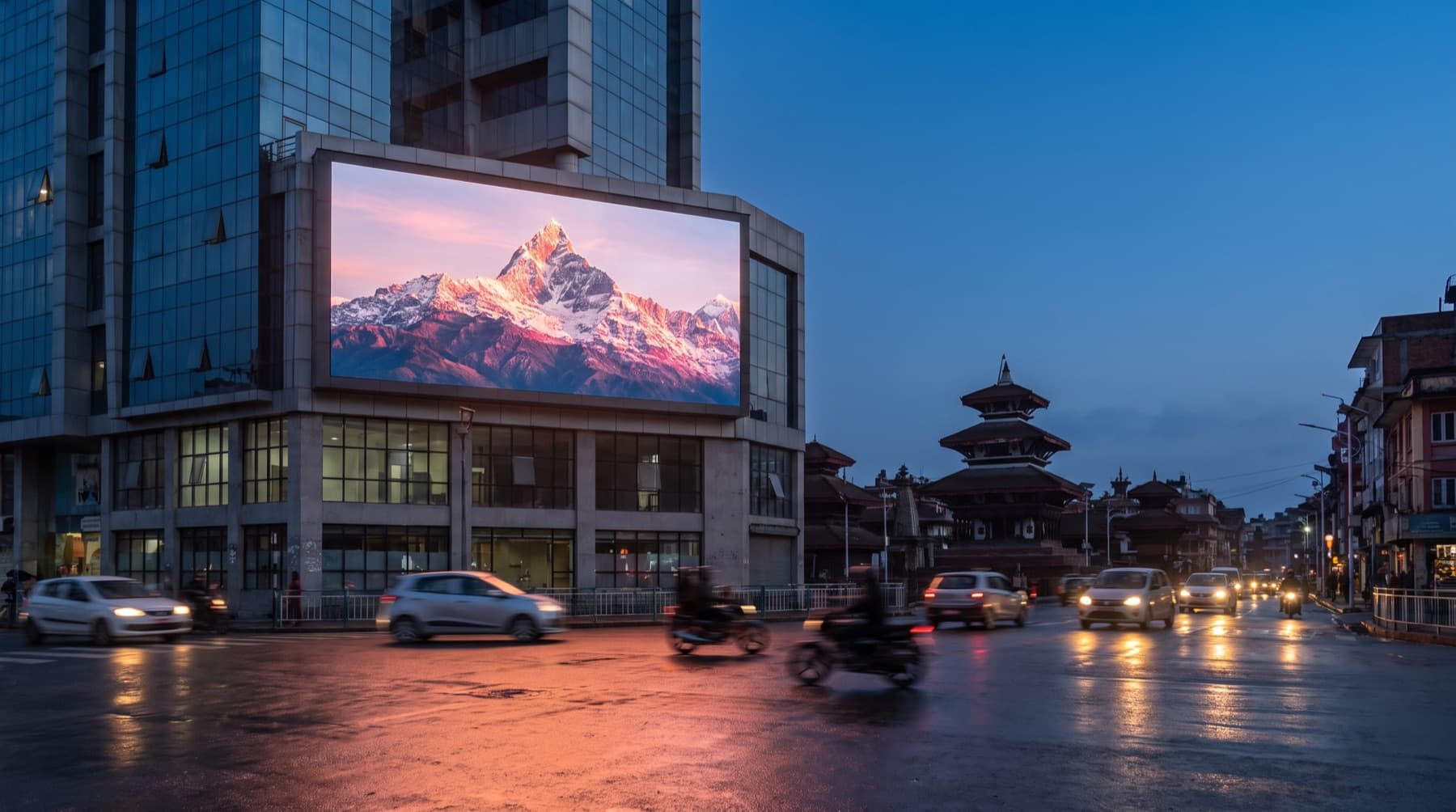
The honest answer to "what does an LED display cost in Nepal" is that the screen area is the least useful number in the quote. Two displays of identical size can differ in price several times over, and the difference is rarely margin — it is pixel pitch, whether it faces the weather, what holds it up, and what the quote quietly leaves out. This guide explains every lever that moves the price, so you can read any quotation and know what you are comparing. We do not publish rate cards, because a price without a site survey is a guess; what follows is how to get to a real figure quickly.
Pixel pitch is the single largest driver
Pixel pitch moves price more than any other factor, and it moves it steeply. A finer pitch packs far more LEDs, driver ICs and processing into the same square metre, so a close-viewing indoor wall can cost several times as much per square metre as a coarse-pitch outdoor screen of the same physical size.
This is why viewing distance decides your budget before size does. If people stand close — a boardroom, a retail interior, a control room — you need a fine pitch and the per-square-metre cost is high. If the audience is across a road or a stadium, a coarse pitch reads perfectly and costs a fraction as much. Specifying a finer pitch than the viewing distance needs is the most common way buyers overspend.
The practical consequence: do not compare two quotes on area alone. A larger coarse-pitch screen can cost less than a smaller fine-pitch one, and both can be correct for their rooms.
Indoor or outdoor changes almost every component
An outdoor screen is not an indoor screen made weatherproof — it is a different build, and it costs more for reasons that have nothing to do with the LEDs. Outdoor cabinets need high brightness to fight daylight, full IP-rated sealing front and rear, and components rated for heat and humidity.
Brightness is the hidden cost here. An outdoor screen may run many times brighter than an indoor one, which means more powerful LEDs, heavier power supplies and more thermal management. Behind glass — a shopfront facing the street — counts as outdoor for brightness even though it is technically indoors, and quoting it as indoor is a common and expensive mistake.
Sealing matters too. A front-only IP rating is cheaper and common, and inadequate for Nepal's monsoon; proper front-and-rear sealing costs more and is what keeps an outdoor screen alive past its first wet season.
Structure and mounting — the line most often forgotten
On outdoor and large projects, the steel structure that holds the screen can be one of the largest single lines in the quote, and it is the one most often left off a cheap one. A roadside billboard needs a foundation and a frame engineered for wind loading; a high wall mount needs access engineering for installation and service.
This is why a quote for panels alone is not a quote for a working display. The structure, the foundation, the rigging and the access all have to be designed and built, and on an exposed outdoor site that engineering is non-trivial. A quote that omits it is not cheaper — it is incomplete, and the difference arrives later as a variation.
Indoors the structural cost is smaller but still real: a flush wall mount, a floor-standing frame and a suspended rig are three different budgets.
The control system and what runs the content
Behind every screen is a processing and control layer — sending and receiving cards, a video processor, and a content management system — and its cost scales with how the screen is used, not with its size. A single static screen needs little; a networked set of screens updated remotely on a schedule needs a proper CMS and more capable processing.
If the screen will ever be filmed — a broadcast backdrop, a stage, a studio — refresh rate becomes a hard requirement, and high-refresh processing costs more. Below a certain refresh the camera records banding the eye never sees, so this is not an upgrade, it is a yes-or-no specification that moves the price.
Who changes the content decides the rest. A laptop and an HDMI cable is nearly free; a cloud CMS that a venue team updates from a phone is a real line item, and the right one to pay for if nobody on site is technical.
Installation, commissioning and the things after handover
Installation, calibration and commissioning are labour, and labour is a genuine part of the cost that a supply-only quote omits entirely. Getting the panels onto the structure, aligning them flat, calibrating colour and brightness across the whole surface, and setting up the content system is skilled work, and it is what separates a screen that looks like one surface from one that looks like tiles.
Spares and warranty belong in the price conversation too. A screen supplied with batch-matched spare modules held in Nepal, under a warranty honoured locally, costs more than a bare import — and it is the difference between a failed module being a visit and being a customs clearance with the wall dark for weeks.
Running cost is the figure nobody quotes. An outdoor screen's power draw over years is a real number, and a brighter-than-necessary specification pays for itself in electricity for the life of the screen.
Why two quotes for "the same screen" rarely match
When two quotations for an apparently identical screen differ sharply, the gap is almost always in what is included, not in the margin. The cheaper one has usually quoted supply only, a front-only IP rating, no structure, no commissioning, or a shorter or overseas-only warranty.
The way to compare fairly is to ask each supplier the same question: is this a quote for a complete, working, installed display, and what exactly does it include? Put the pixel pitch, the IP rating front and rear, the structure, the control system, the installation, the warranty and the held spares on one line each, and the quotes become comparable. Without that, the lowest number usually just has the most left out.
This is also why we quote after a site survey rather than from a price list. The site decides the structure, the brightness and the access, and those decide the price. A figure given before anyone has seen the site is a number we would have to revise — which helps nobody.
How to get an accurate quote in one round
You can get to a firm quotation quickly by bringing the few facts that drive the whole specification. Tell us where the screen goes and how far away the nearest regular viewer stands; whether it is indoor, outdoor or behind glass; the surface size you have to work with; whether it will ever be filmed; who will change the content; and, for a tender, the documentation the tender requires.
With those, we can specify the pitch, brightness, structure and control system and come back with an indicative specification and price in a single round rather than several. A free site survey confirms the structure and access before anything is committed, so the price we quote is a price rather than an estimate.
The short version
- Pixel pitch drives price more than size — a small fine-pitch wall can cost more than a large coarse-pitch one.
- Viewing distance sets the pitch, so it sets the budget before size does.
- Outdoor costs more for brightness and front-and-rear sealing, not just weatherproofing; behind glass counts as outdoor.
- Structure is often the largest line on an outdoor quote and the one a cheap quote omits.
- A quote for panels is not a quote for a working display — compare what's included, not the headline number.
- A price before a site survey is a guess; bring the six facts above and we quote in one round.
Common questions
How much does an LED display cost in Nepal?
There is no single figure, because price is driven by pixel pitch, size, indoor versus outdoor, the mounting structure, the control system and installation — not by screen area alone. A fine-pitch indoor wall can cost several times as much per square metre as a coarse-pitch outdoor screen of the same size. The reliable way to a real price is a site survey; a figure quoted before one is an estimate that will be revised.
Why is a fine-pitch LED screen so much more expensive?
A finer pixel pitch packs far more LEDs, driver ICs and processing into each square metre, so cost rises steeply as pitch gets finer. You only need a fine pitch when people view the screen from close up — specifying finer than the viewing distance requires is the most common way buyers overspend.
Why is an outdoor LED display more expensive than an indoor one of the same size?
An outdoor screen runs much brighter to fight daylight, which means more powerful LEDs, heavier power supplies and more cooling, and it needs full IP sealing front and rear to survive the monsoon. It also needs an engineered steel structure rated for wind loading. None of that is about the LEDs themselves — it is why the same screen area costs more outdoors.
Why do two quotes for the same LED screen differ so much?
Almost always because of what is included, not margin. A cheaper quote has usually left off the mounting structure, quoted a front-only IP rating, excluded commissioning, or offered a shorter or overseas-only warranty. Ask each supplier whether the quote is for a complete installed display and compare the inclusions line by line.
What is the biggest hidden cost in an LED display quote?
On outdoor and large projects, the steel structure and foundation — engineered for wind loading and access — is often the single largest line and the one most often omitted from a cheap quote. Power work and commissioning are the next most commonly left off.
Can you give me a price without visiting the site?
We can give an indicative specification, but an accurate price needs a site survey, because the structure, brightness and access that drive most of the cost are decided by the site. Bring the viewing distance, indoor/outdoor, surface size, whether it will be filmed and who manages content, and we can scope it quickly and confirm with a free survey.
Where to go next
Want this applied to your site?
We survey the site free, then spec the pitch, brightness and structure around what it actually needs.
Book a site survey