Guides / Cities & Regions
LED displays in Biratnagar, Itahari and Dharan
6 min read · Updated November 2026
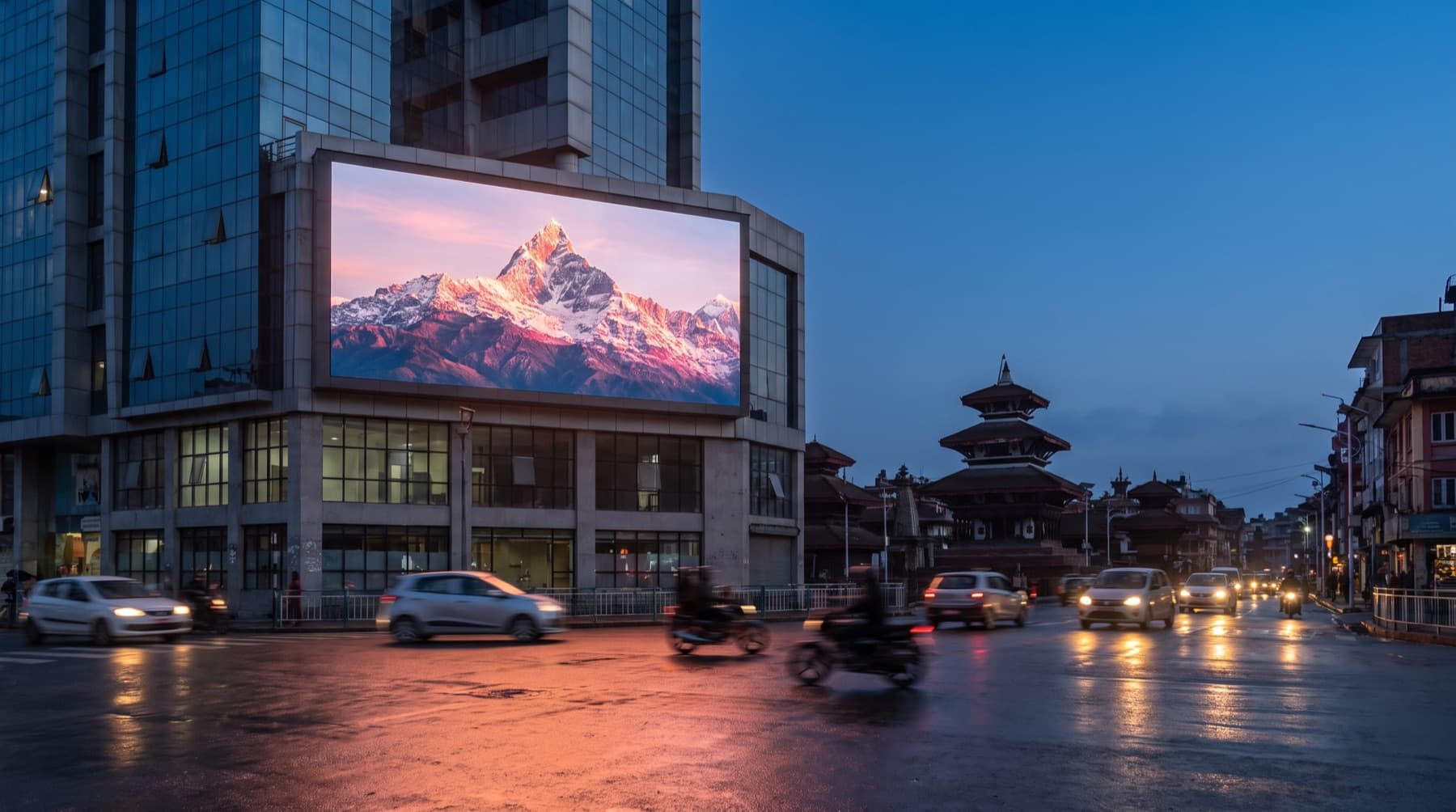
Biratnagar, Itahari and Dharan form the commercial heart of eastern Nepal, and although they sit close together they ask different things of an LED display. Biratnagar is an industrial and trading city on the plains, Itahari is a highway junction town, and Dharan sits where the plains meet the hills. Across all three, outdoor screens need outdoor brightness, IP65 sealing front and rear, good ventilation for the Terai heat and solid power protection; the pixel pitch and format then depend on whether the screen faces a highway, a market street or a venue interior.
How do Biratnagar, Itahari and Dharan differ as LED markets?
The three cities share a region but not a profile, so the right screen differs between them. Biratnagar has a large commercial and industrial base, with demand from retail, banks, showrooms, hospitals, colleges and corporate offices. Itahari is defined by its junction on the East–West Highway, which makes roadside DOOH particularly relevant. Dharan has a lively hospitality and education scene and a more compact, hillside town centre.
Those differences decide the specification. A highway-facing screen in Itahari is read from a distance by moving traffic and suits a coarse pitch; a shopfront in Biratnagar’s market areas is read from a few metres; a restaurant or college in Dharan often needs an indoor or semi-outdoor screen sized for its own space.
Purwanchal Cafe in Itahari, where we installed a P4 screen, reflects a common format in the region: a hospitality screen at a pitch suited to viewers at close range.
Which pitch suits highway and street sites in the east?
Highway-facing screens in Itahari and on Biratnagar’s main roads usually suit P8 to P10, while street-level shop and restaurant screens suit P3 to P4. Pixel pitch in millimetres roughly equals the closest comfortable viewing distance in metres, so the question is always where the nearest regular viewer stands.
Highway screens should also be oriented for approaching traffic rather than for traffic already passing. A face angled to be visible for the longest stretch of approach gives drivers more time to read it, which matters more than raw size.
Indoor screens — in banks, showrooms, college halls and hospitals — use finer pitches chosen for the room, typically P2.5 to P4 for lobbies and halls, and finer still for close-viewing meeting rooms.
How do heat and humidity affect screens in the eastern Terai?
The eastern Terai combines hot pre-monsoon weather with a long, humid monsoon, so outdoor screens must be designed for heat and moisture together. Heat accelerates the ageing of LEDs, driver ICs and power supplies; humidity encourages condensation and corrosion inside poorly sealed cabinets.
The specification should include IP65 sealing on both front and rear, cabinets rated for outdoor thermal loads, an air gap behind the screen and, for large or enclosed installations, forced ventilation. Brightness should be controlled automatically so the screen runs below full output when it does not need it, reducing both heat and power.
Dharan’s hillside sites add rain run-off and wind exposure, so drainage and structural design deserve particular attention there.
What power protection do screens in the east need?
Outdoor and indoor screens alike should have a stabiliser or UPS, surge protection and good earthing, and exposed outdoor structures should have lightning protection. Industrial areas around Biratnagar can see voltage disturbances from heavy loads, and storms in the monsoon bring surge and lightning risk across the region.
Large DOOH screens draw substantial power at full brightness, so confirm the supply capacity at the site before the structure goes up. A three-phase supply is often required for large outdoor faces.
For screens that must keep running through cuts, such as hospital information displays or bank queue screens, plan backup power alongside the screen rather than adding it later.
Which businesses in the region benefit most from LED screens?
Retail, hospitality, banks, education and DOOH operators are the strongest users of LED screens in Biratnagar, Itahari and Dharan. Shops and showrooms use screens to show products and offers; restaurants and party venues use them for menus, events and live sport; banks and cooperatives use them for rates and notices; colleges use them in halls and at entrances.
Party palaces and wedding venues are a particular opportunity in the region. An indoor LED wall replaces projectors and printed backdrops and can be reused for every event, which suits venues with a full wedding season.
DOOH operators should think in terms of networks rather than single screens. A small number of well-placed faces in Biratnagar, Itahari and Dharan, managed from one content system, gives advertisers regional reach.
How do installation and service work in the east?
We install in Biratnagar, Itahari and Dharan with our own team after a free site survey, and do not subcontract installation. A standard screen takes two to three days on site including structure; larger or more complex installations take five to seven days.
Our LED displays carry a two-year manufacturer warranty honoured locally, with spares held in Kathmandu. For screens far from the Valley we recommend keeping a few batch-matched spare modules and a spare power supply on site, so that simple faults can be fixed quickly with remote support from our engineers.
Outdoor screens generally involve the metropolitan, sub-metropolitan or municipal office and the ward, and requirements vary and change over time. Check with the relevant office before committing to a site.
The short version
- Biratnagar, Itahari and Dharan suit different screen formats despite being close together.
- Highway screens usually suit P8 to P10; shop and restaurant screens P3 to P4.
- Eastern Terai heat and humidity demand IP65 front-and-rear sealing and good ventilation.
- Stabilisers, surge protection, earthing and lightning protection belong in every outdoor install.
- Wedding venues and party palaces can use indoor LED walls in place of projectors and printed backdrops.
- On-site spares and remote support shorten repair times far from Kathmandu.
Common questions
Do you install LED displays in Biratnagar?
Yes. Our own team installs in Biratnagar, Itahari and Dharan after a free site survey. A standard screen usually takes two to three days on site including structure.
What LED screen suits a highway billboard in Itahari?
A highway billboard in Itahari is typically an outdoor screen at P8 to P10, with outdoor brightness and IP65 sealing on both front and rear. It should be angled towards approaching traffic for the longest reading time. The exact size depends on the site and structure.
Which LED screen is best for a party palace in Biratnagar?
Most party palaces use an indoor LED wall at around P2.5 to P3.9, sized to the stage and room. It replaces projectors and printed backdrops and can be reused for every event. Viewing distance from the front row decides the exact pitch.
How do LED screens cope with summer heat in eastern Nepal?
Well-designed outdoor cabinets cope with Terai heat when there is air space behind the screen and brightness is controlled automatically. Larger installations may need forced ventilation. Heat management should be part of the design rather than an afterthought.
How long does a repair take for an LED screen in Dharan?
Simple faults such as a failed module or power supply can be fixed quickly if batch-matched spares are kept on site. Our engineers support remotely and travel for larger faults. Displays carry a two-year manufacturer warranty honoured locally.
Where to go next
More in Cities & Regions
Want this applied to your site?
We survey the site free, then spec the pitch, brightness and structure around what it actually needs.
Book a site survey