Guides / Cities & Regions
LED displays in Pokhara: tourism, lakeside and outdoor sites
6 min read · Updated November 2026
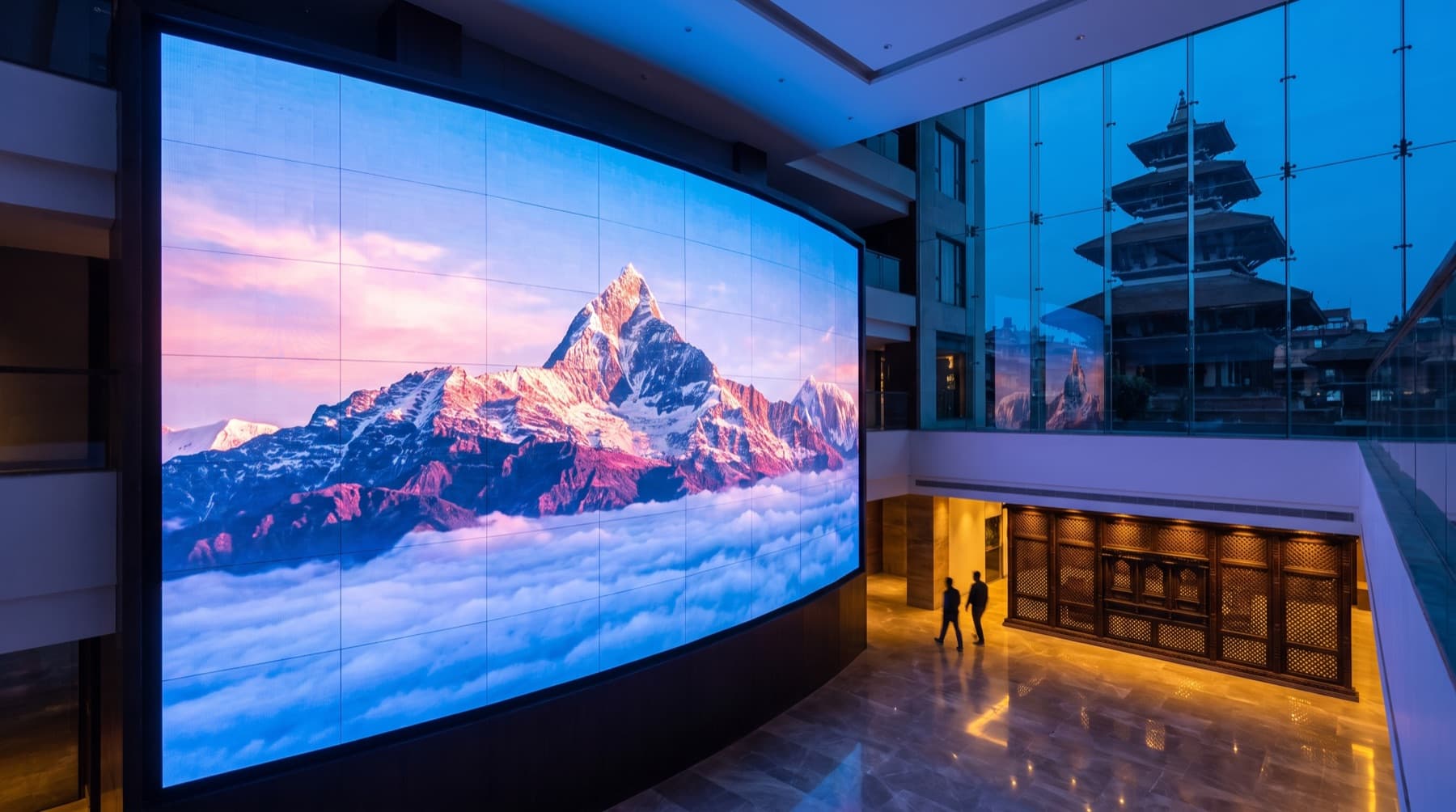
Pokhara is one of the wettest cities in Nepal and one of the most tourism-driven, and both facts shape its LED displays. Outdoor screens here need excellent rain sealing and high brightness for an open, bright sky, while most demand comes from hotels, restaurants, adventure operators and event venues serving visitors. A well-specified Pokhara screen is sealed to IP65 front and rear, bright enough for Lakeside afternoons, simple to update remotely and supported by spares held in Nepal.
Why does Pokhara’s rainfall matter so much?
Pokhara receives far heavier monsoon rain than Kathmandu, so weather sealing is the first specification to get right for any outdoor screen there. Long, intense downpours and high humidity test every joint, cable gland and vent on a cabinet.
We specify IP65 sealing on both the front and the rear of every outdoor cabinet in Pokhara, never front-only. The rear is where power supplies and receiving cards sit, and in sustained wind-driven rain a front-only cabinet can take in water through the back. Cable entries need proper glands and drip loops, and the structure should shed water away from the screen rather than channelling it down the cabinet seams.
Humidity also matters out of season. A screen that runs daily keeps itself warm and dry inside; one that sits switched off for weeks during a quiet period can collect condensation, so we advise a short daily run even when there is no content to show.
How bright does an outdoor screen in Pokhara need to be?
An outdoor screen in Pokhara facing open sky or the lake should be specified in the outdoor range of roughly 5,000 to 8,000 nits. Lakeside and open-ground sites often have little shade, and reflected light from water and pale buildings makes a dim screen look washed out.
Brightness should then be controlled, not left at maximum. An automatic light sensor or a schedule that dims the screen after sunset avoids glare for guests and neighbours and cuts power use considerably — important on a street lined with hotels where a harsh screen at night draws complaints.
Screens behind glass, such as in a café window facing the street, should be treated as outdoor for brightness even though they are inside, because they are competing with daylight on the other side of the glass.
What kinds of businesses use LED screens in Pokhara?
Most Pokhara demand comes from hospitality and tourism: restaurants and bars, hotels and resorts, adventure and trekking operators, and event venues. These businesses use screens for menus and promotions, live sport, event backdrops and guest information.
Coffee Break restaurant in Pokhara is a good example of the typical scale: a Lampro LDT P4 outdoor screen of around 11 m². For a restaurant frontage read by people walking past and sitting nearby, P4 suits the distance well, giving a clean image at a few metres without the cost of a finer pitch.
Hotels tend to want indoor screens for lobbies, conference rooms and banquet halls, where a fine-pitch wall replaces a projector for weddings, conferences and presentations. Event and festival organisers usually rent rather than buy, because their use is seasonal.
How do you manage content for a tourist audience?
Content for a visitor audience should be short, visual and bilingual where it matters. Many viewers are domestic tourists, many are international, and most are passing rather than standing, so a few seconds per message is realistic.
A cloud-based content management system lets a restaurant or hotel change menus, events and offers from a phone without anyone touching the screen. For a business with seasonal peaks — around Dashain and Tihar, the trekking seasons and holidays — scheduled playlists can switch content automatically by time of day and by season.
Keep a small library of evergreen content for quiet periods. A screen showing a frozen or out-of-date promotion looks worse than one showing a simple, well-designed brand loop.
How does installation and service work outside Kathmandu?
We install in Pokhara with our own team from Kathmandu, and a standard outdoor installation usually takes two to three days on site including the structure. Larger spans or complex mounting can take five to seven days, and the free site survey beforehand confirms structure, access and power so there are no surprises on installation day.
Service planning matters more outside the Valley. We recommend that Pokhara clients keep a small set of batch-matched spare modules and a spare power supply on site, so a simple fault can be fixed the same day by swapping a part, with our engineers supporting remotely.
Displays carry a two-year manufacturer warranty honoured locally, and our spares are held in Kathmandu — a road trip away rather than an import and customs clearance.
What about power, approvals and structures in Pokhara?
Power protection, local approvals and wind-aware structures are as important in Pokhara as in the Valley. Voltage fluctuations still occur, so a stabiliser or UPS with surge protection is a sensible part of every installation, and good earthing matters on exposed lakeside and hillside sites.
Outdoor screens generally involve the metropolitan city and the ward office. Requirements vary and change, so check with the municipality and ward office before committing to a site, particularly near the lake shore or in areas with tourism-related planning controls.
Structures should be designed for wind and seismic loads, and for rooftop sites the building itself must be checked. These points are covered in the site survey before any firm quotation.
The short version
- Pokhara’s heavy monsoon makes IP65 front-and-rear sealing essential for outdoor screens.
- Lakeside and open sites need outdoor brightness, controlled by a light sensor or dimming schedule.
- Hospitality and tourism businesses account for most LED demand in Pokhara.
- P4 outdoor suits most restaurant and street-level screens viewed from a few metres.
- Keeping batch-matched spares on site shortens repairs outside Kathmandu.
- Standard outdoor installations take two to three days on site, including structure.
Common questions
Which LED screen is best for a restaurant in Lakeside, Pokhara?
For a restaurant screen read by passers-by and diners a few metres away, an outdoor P4 screen sealed to IP65 front and rear is a common, sensible choice. It should be bright enough for daylight and dimmed automatically in the evening. A cloud CMS lets staff update menus and offers from a phone.
Can an LED screen survive the monsoon in Pokhara?
Yes, if it is properly sealed and installed. Specify IP65 on both the front and rear of every cabinet, use proper cable glands and design the structure to shed water. Running the screen daily also helps keep the internals dry through humid months.
Do you install LED displays in Pokhara?
Yes. Our own team installs in Pokhara, and a standard outdoor screen usually takes two to three days on site including structure. We carry out a free site survey first to confirm structure, access and power before giving a firm quotation.
Should a Pokhara event company buy or rent an LED screen?
If events are seasonal or occasional, renting is usually more economical, because the screen sits idle between bookings. Buying makes sense when the screen will be used frequently enough to justify ownership, storage and maintenance. Compare your expected number of event days per year with rental costs before deciding.
How are LED screens in Pokhara repaired if something fails?
Most simple faults are fixed by swapping a module or power supply, which is why we recommend keeping a few batch-matched spares on site. Our engineers support remotely and travel from Kathmandu for larger faults. Displays carry a two-year manufacturer warranty honoured locally.
Where to go next
More in Cities & Regions
Want this applied to your site?
We survey the site free, then spec the pitch, brightness and structure around what it actually needs.
Book a site survey