Guides / Cities & Regions
LED displays in the Kathmandu Valley: what’s different here
7 min read · Updated October 2026
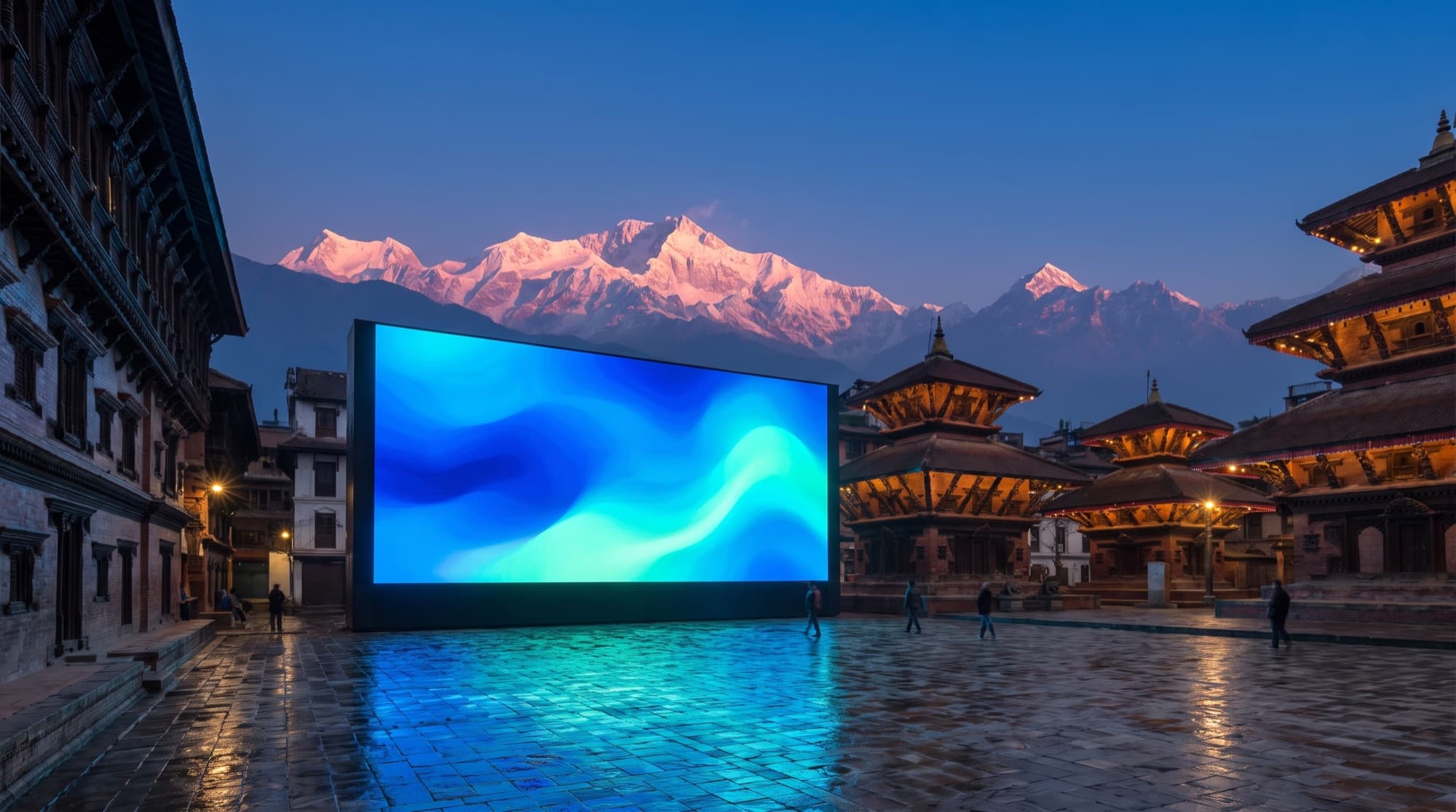
An LED display in the Kathmandu Valley faces a specific mix of conditions: heavy dust in the dry season, intense monsoon rain, short viewing distances on narrow streets, unstable power and seismic risk. A screen that suits an open highway in the Terai is often the wrong specification for a Thamel lane or a Lalitpur courtyard. The right Valley screen is usually a slightly finer pitch than you would expect, sealed front and rear, protected against voltage swings and mounted to a structure designed with earthquakes in mind.
Why do viewing distances in the Valley push towards finer pitch?
Most Valley screens are seen from closer than their owners expect, so they often need a finer pixel pitch than a similar-sized screen elsewhere in Nepal. Streets in the old cores of Kathmandu, Patan and Bhaktapur are narrow, buildings sit close together and pedestrians pass within a few metres of a shopfront or a ward notice board.
The working rule is that pixel pitch in millimetres roughly equals the closest comfortable viewing distance in metres. On a wide ring-road junction a P8 or P10 screen reads cleanly from across the carriageway; on a lane where the nearest viewer is four metres away, P4 or finer is the sensible starting point. The outdoor board we installed for Tokha Municipality Ward No. 5 is P6 — a pitch that suits a public notice board read from nearby rather than a billboard read from across a highway.
Getting this wrong in either direction is costly. Too coarse and the image looks like a grid of dots to the people actually walking past; too fine and you pay steeply for detail nobody stands close enough to see.
How do dust and monsoon affect a Kathmandu screen?
Valley outdoor screens must survive two opposite seasons: months of fine dust followed by months of driving rain, and both attack the same weak points. Dust from roads and construction settles into vents and on module faces, and the monsoon then drives water at the same gaps.
This is why we specify IP65 sealing on the front and the rear of every outdoor cabinet. A front-only rating may pass a showroom test but leaves the back of the screen — where the power supplies and receiving cards live — exposed to wind-driven rain and humid air. Front-and-rear sealing, plus a structure that sheds water rather than channelling it into the cabinet joints, is what keeps a Valley screen running past its second monsoon.
Dust also changes the maintenance plan. A screen on a busy road in Kathmandu needs its faces and ventilation paths cleaned more often than one in a quieter suburb, and a service contract should say how often that happens.
What does power in the Valley mean for an LED display?
Power in the Valley is far more reliable than it once was, but voltage swings, brief cuts and surges are still common enough that every screen should be protected. LED power supplies tolerate a range of input voltages, yet repeated spikes and brownouts shorten their life and can damage receiving cards.
The practical answer is a stabiliser or online UPS sized to the screen’s real draw, a properly earthed supply and surge protection on the incoming line. For a screen that must stay on through short cuts — a ward notice board, a bank lobby, a control room — a UPS that can bridge to a generator is worth planning from the start rather than retrofitting.
Brightness scheduling helps here too. An outdoor screen dimmed automatically after dark draws much less power through the evening hours, which eases the load on the circuit and the backup system.
Do earthquakes change how a screen is mounted?
Yes — in the Valley the structure behind the screen should be designed for seismic movement as well as for weight and wind. A wall-mounted or roof-mounted screen is a heavy, rigid mass fixed high on a building, and during shaking its fixings carry loads well beyond its static weight.
In practice that means anchoring into structural members rather than infill brick, using bracing that keeps the frame from racking, and checking that the building element itself can carry the load. On older buildings in the heritage cores, the honest answer is sometimes that the wall cannot take a screen and a freestanding frame is the safer choice.
We assess this during the free site survey, before any specification is fixed, because the structure decides both what is safe and a large part of what the project costs.
Are there approval or heritage considerations in the Valley?
Outdoor screens in the Valley usually involve the municipality or ward office, and sites in or near heritage zones may face additional scrutiny. Requirements vary between Kathmandu, Lalitpur, Bhaktapur and the surrounding municipalities, and they change over time, so check with the relevant municipality and ward office before committing to a site.
Heritage areas deserve particular care. A bright screen beside a temple square or a traditional Newari façade can be inappropriate even where it is technically allowed, and brightness, size and operating hours may matter as much as the permission itself. Indoor screens, screens behind shop glass and screens inside courtyards often avoid these questions entirely.
The old cores are still active markets for well-placed screens: our installations include a BNX 2.5 screen at Gwakhancha Restro & Bar in Taumadhi, Bhaktapur. The lesson for heritage settings is to size and place the screen for the venue and its guests, not to dominate the square.
What kinds of screens are most common across the Valley?
The Valley has the widest range of LED applications in Nepal, from fine-pitch boardroom walls to large building-mounted billboards. Corporate offices, banks, hotels and colleges account for most indoor work; roadside and building-wrap DOOH, ward information boards and restaurant screens account for most outdoor work.
That range shows in our own installations: Nepal’s first COB LED control room, a P1.5 wall in a Kathmandu corporate office; the P5 outdoor screen at the National Soil Science Research Centre in Lalitpur; a curved P2.5 hotel lobby wall in Thamel; and building-mounted outdoor billboards in Naxal and elsewhere in Kathmandu.
Because our team, stock and spares are based in Kathmandu, Valley projects also have the shortest response times for service — a failed module is usually a same-week visit rather than a planned trip.
The short version
- Valley screens are often viewed from a few metres, so they usually need a finer pixel pitch than highway screens.
- Outdoor screens in Kathmandu should be sealed to IP65 on both front and rear to survive dust and monsoon.
- Voltage swings and surges make a stabiliser or UPS and proper earthing part of every Valley installation.
- Wall and roof mounts should be engineered for seismic loads, not just static weight.
- Outdoor approvals vary by municipality and ward; check locally before committing to a site.
- Kathmandu-based spares and engineers mean the fastest service response anywhere in Nepal.
Common questions
What pixel pitch should I use for a shop screen in Kathmandu?
Use the distance of the nearest regular viewer as your guide: pixel pitch in millimetres roughly equals the closest comfortable viewing distance in metres. On a narrow street where people pass within three or four metres, P3 to P4 is a sensible starting point. On a wide junction viewed from across the road, P6 to P10 is usually enough.
Do I need permission for an outdoor LED screen in Lalitpur or Bhaktapur?
Outdoor screens generally involve the municipality and ward office, and heritage areas can face additional review. Requirements differ between municipalities and change over time. Check with the relevant municipality and ward office before you commit to a site or sign a supply contract.
Will dust damage an outdoor LED display in Kathmandu?
Dust will not damage a properly sealed screen quickly, but it does build up on module faces and in ventilation paths. A screen sealed to IP65 front and rear and cleaned on a regular schedule copes well. Screens on busy roads need more frequent cleaning than those in quieter areas.
Do I need a UPS for an LED screen in the Kathmandu Valley?
A UPS or stabiliser with surge protection is strongly recommended for any Valley screen. Voltage swings and spikes shorten the life of power supplies and can damage receiving cards. Screens that must stay on through cuts, such as notice boards or control rooms, should have backup planned from the start.
How quickly can a failed LED screen in Kathmandu be repaired?
Because our engineers and spare modules are based in Kathmandu, most Valley repairs are handled within days rather than weeks. Displays carry a two-year manufacturer warranty honoured locally. Keeping a few batch-matched spare modules on site makes simple repairs faster still.
Where to go next
Want this applied to your site?
We survey the site free, then spec the pitch, brightness and structure around what it actually needs.
Book a site survey