Guides / Technology Explained
IP65 and LED displays: front and rear sealing explained
7 min read · Updated October 2026
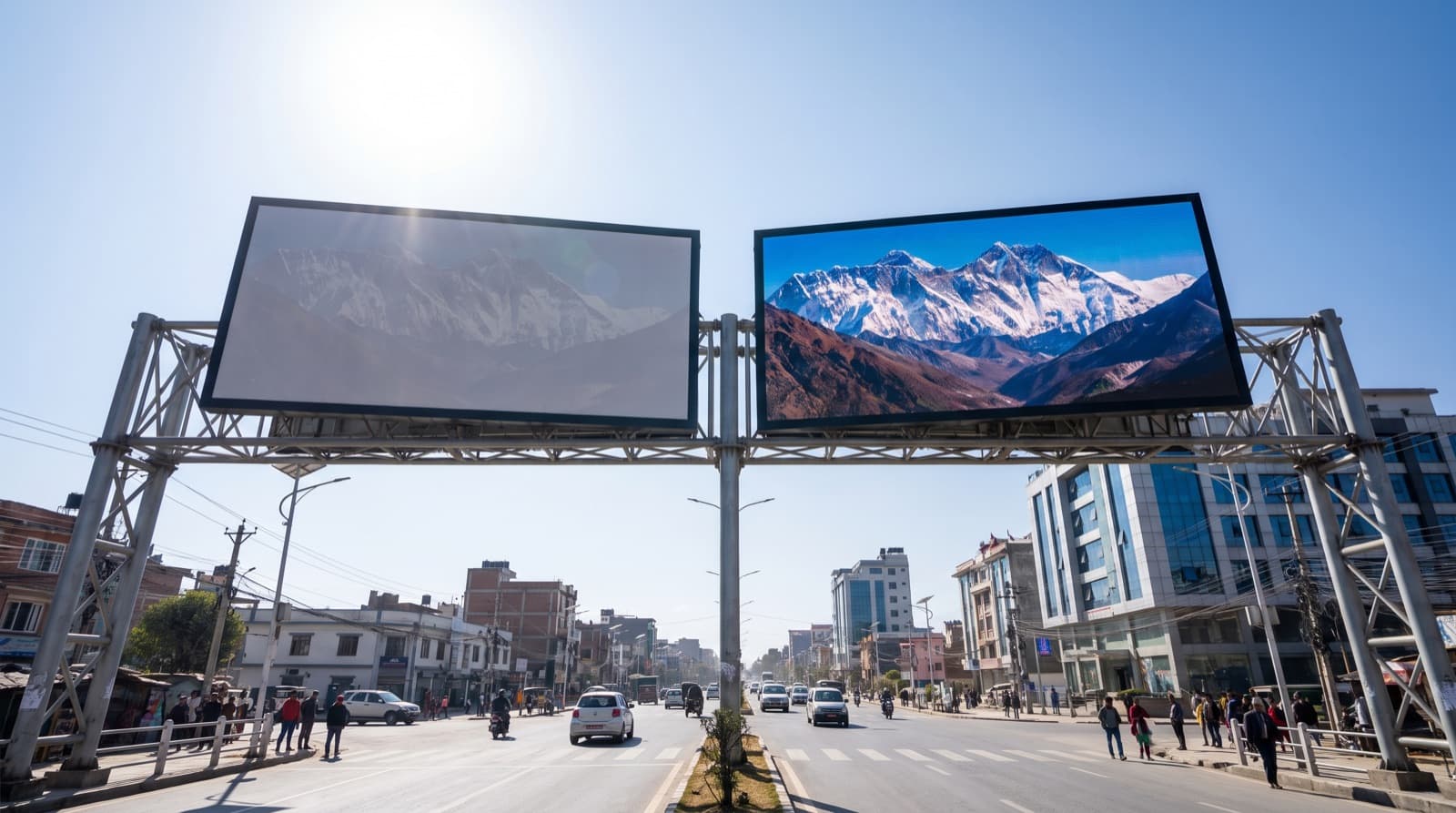
IP65 means a display enclosure is fully protected against dust and against water jets from any direction. On an outdoor LED screen in Nepal it must apply to the front and the rear of the cabinet, because monsoon rain is driven sideways and pools behind the screen as well as striking the face. A screen rated IP65 on the front only is an indoor-grade back with an outdoor-grade face, and it is the commonest reason outdoor screens fail in their first or second wet season.
What does IP65 actually mean?
IP65 is a two-part rating from the international Ingress Protection standard: the first digit, 6, means dust-tight, and the second, 5, means protected against low-pressure water jets from any angle. It is a test result for an enclosure, not a quality badge, and it says nothing about brightness, colour or lifespan.
The digits are independent. A cabinet can be dust-tight but only drip-proof, or splash-proof but not dust-tight, and each combination gets its own code. For outdoor LED in Nepal the useful floor is 6 for dust — Kathmandu’s winter dust and Terai road dust are fine enough to coat driver boards — and 5 for water, because monsoon rain arrives with wind behind it.
IP66 and IP67 exist and are higher ratings against powerful jets and temporary immersion. They are rarely necessary for a wall-mounted or pole-mounted billboard and add weight and cost; IP65 sealed properly on every face is the practical standard for permanent outdoor screens.
Why does front-only IP65 fail in the monsoon?
A front-only rating protects the LED face but leaves the rear of the cabinet — power supplies, receiving cards, cable entries — open to water and dust. On a spec sheet it often appears as “IP65 front / IP54 rear” or simply “IP65 (front)”, and it is cheaper to build because the back can use vents and simple covers.
In a dry climate that compromise can survive. In Nepal it does not, because monsoon rain is wind-driven, structures channel water down the back of the screen, and humidity condenses inside any cabinet that breathes freely. The first signs are corroded connectors and failing power supplies; the next is whole cabinets dropping out after a storm.
This is why our outdoor specifications state IP65 front and rear as a single line, and why we recommend any buyer comparing quotes asks that question in writing. If a supplier will only commit to the front figure, assume the rear is not sealed.
Where does water get in on a sealed cabinet?
Water rarely comes through the cabinet wall; it comes through the joints, cable entries and service openings that the IP test assumes are closed properly. A cabinet that passed IP65 in the factory can be compromised on site by an unsealed cable gland, a missing gasket on a rear door, or a cable run that slopes towards the cabinet and carries water in.
Installation therefore matters as much as the rating. Cables should enter from below with drip loops, glands should be the correct size for the cable, rear doors and service hatches should close on intact gaskets, and the structure should shed water away from the screen rather than funnel it behind.
Front-service cabinets add another joint to watch — the module face itself is the service opening. Good front-service outdoor modules seal each module to the cabinet with its own gasket; it is worth asking how the module is sealed, not only how the cabinet is rated.
Does IP65 make a screen suitable for outdoor use on its own?
No — IP65 is necessary for an outdoor LED screen in Nepal, but it is not sufficient. An outdoor screen also needs brightness in the 5,000–8,000 nit range to stay readable in daylight, components rated for heat and humidity, and a structure engineered for wind.
Brightness is the commonest gap after sealing. A sealed cabinet with indoor-level brightness will survive the weather and still be unreadable at noon. Equally, a very bright screen without proper sealing will look excellent for one dry season. The two specifications have to arrive together.
Behind shop glass the logic flips slightly: the screen is protected from rain, so the IP rating matters less, but it still faces direct sun and needs outdoor-level brightness. Treat it as outdoor for brightness and as indoor for sealing, with good ventilation because glass traps heat.
What about heat, ventilation and condensation?
A sealed cabinet still has to get rid of heat, and the way it does so is part of the outdoor design rather than an afterthought. Well-designed IP65 cabinets conduct heat out through the cabinet body, often die-cast aluminium, instead of relying on open vents that would let water and dust in.
Condensation is the quieter risk. When a warm cabinet cools overnight in humid months, moisture can form inside if the enclosure breathes. Proper sealing, conformal coating on boards and keeping the screen powered on a schedule rather than switched fully off for long wet periods all reduce it.
In the Terai, where summer heat is higher and dust heavier, a sealed cabinet with good conduction cooling ages far better than a vented one. In the hills the concern shifts towards cold mornings, condensation and lightning, which is a separate protection question.
How do you check an IP65 claim before buying?
Ask for the IP rating of the front and the rear separately, in writing, and ask to see the cabinet’s rear. A genuinely sealed rear has no open vent slots, uses sealed cable glands or waterproof connectors, and closes service doors on gaskets.
Look at the modules and connectors too. Outdoor modules should have waterproof power and data connectors between cabinets, and the module face should show a gasket or sealed frame rather than a bare edge. A test report from the manufacturer is useful, but the physical inspection tells you whether that report applies to the product you are actually being offered.
Finally, ask how the installer seals cable entries on site. A rating only holds if the installation preserves it. Our outdoor installs, including the P5 screen at the National Soil Science Research Centre in Lalitpur and the P6 ward display in Tokha, are specified IP65 front and rear and installed with that in mind — if you are planning an outdoor screen, ask us for a site survey and we will show you what we check.
The short version
- IP65 means dust-tight and protected against water jets from any direction.
- For outdoor LED in Nepal, IP65 must apply to the front and the rear of every cabinet.
- Front-only ratings leave power supplies and cards exposed to wind-driven monsoon rain.
- Most water enters through cable entries, gaskets and service doors, so installation matters as much as the rating.
- IP65 is necessary but not sufficient: outdoor screens also need 5,000–8,000+ nits and a wind-rated structure.
- Ask for front and rear ratings separately, in writing, and inspect the rear of the cabinet.
Common questions
Is IP65 enough for an outdoor LED screen in Nepal?
Yes, provided IP65 applies to both the front and the rear of every cabinet and the installation keeps the seals intact. IP66 or IP67 are rarely needed for a wall- or pole-mounted billboard. The rating also has to be matched with outdoor brightness and a properly engineered structure.
What is the difference between IP65 and IP54 on an LED display?
IP65 is dust-tight and resists water jets from any direction, while IP54 is only dust-protected and resists splashing. IP54 is common on the rear of cheaper outdoor cabinets. In Nepal’s monsoon an IP54 rear lets water and dust reach the power supplies and receiving cards.
Can I use an indoor LED screen outdoors under a roof?
Generally not. A canopy stops direct rain but not wind-driven spray, humidity, dust or daylight, and an indoor screen will be too dim to read outdoors. A semi-outdoor location still needs sealed cabinets and outdoor-level brightness.
Does a screen behind a shop window need IP65?
Sealing is less critical behind glass because the screen is out of the rain, but brightness is not. A window-facing screen needs outdoor-level brightness to beat sunlight and good ventilation, because glass traps heat in the display zone.
How can I tell if an LED cabinet is sealed at the back?
A sealed rear has no open vent slots, uses waterproof cable glands or connectors, and closes service doors on rubber gaskets. Ask the supplier for the rear IP rating in writing. If they only state a front figure, assume the rear is not fully sealed.
Where to go next
More in Technology Explained
Want this applied to your site?
We survey the site free, then spec the pitch, brightness and structure around what it actually needs.
Book a site survey