Guides / Industry Guides
LED displays for government offices in Nepal
7 min read · Updated October 2026
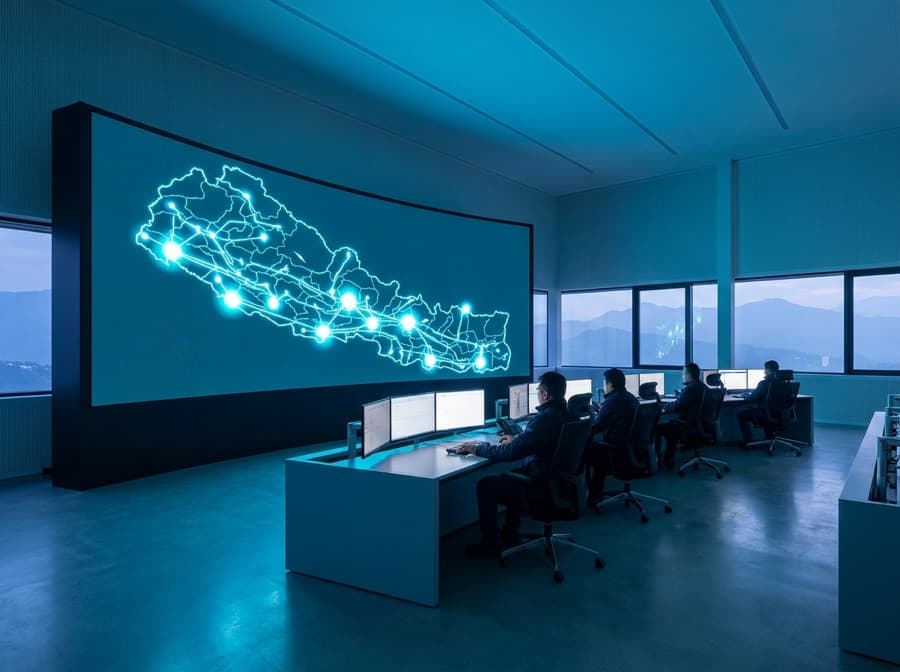
Government offices in Nepal use LED displays for three main jobs: outdoor public information boards, indoor service-hall and queue displays, and video walls in briefing, monitoring or meeting rooms. Each needs a different specification — outdoor boards need 5,000+ nits and IP65 front and rear, briefing walls need fine pitch at low brightness. Because most purchases go through public procurement, a clear, vendor-neutral specification and complete supplier documentation matter as much as the screen itself.
Where government offices use LED displays
The most common government use is a public information board facing the street or the office courtyard, showing notices, service information and public awareness messages. These replace paper notice boards that fade, get covered over or cannot be read after dark.
Inside, service halls use displays for token numbers, service lists, required documents and opening hours, which reduces the queue of people asking the same questions at the counter. Ministries, departments and agencies with monitoring or coordination functions use LED video walls to show dashboards, maps, camera feeds and video conferences in one view.
Research centres, training institutes and offices with auditoriums also use LED walls in halls for presentations and events. One example from our own work is the National Soil Science Research Centre in Lalitpur, under the Ministry of Agriculture, where we installed a P5 outdoor display of 4 × 2.5 m at 6,000 nits, sealed to IP65.
Outdoor notice boards: what to specify
An outdoor government notice board should be outdoor-rated end to end: 5,000 nits or more, IP65 front and rear, and a pitch chosen from the viewing distance — typically P4–P6 for a courtyard or roadside within twenty metres. Notices are mostly text, and text needs enough pixels to stay legible, so do not choose a coarse pitch purely to save cost.
Automatic brightness control is important for an office board that runs into the evening. Without it, a screen bright enough for midday glares at night and draws complaints from neighbours. Scheduled on and off times keep running costs down and extend component life.
The structure deserves as much attention as the screen. A pole or wall mount must be engineered for wind and earthquake loading, and in many government compounds the building itself needs checking before a heavy cabinet is fixed to it.
Briefing rooms and monitoring walls
For a briefing room or monitoring wall where people sit two to four metres away, a fine pitch of roughly P1.2–P1.9 at low brightness — around 600 nits — is the usual starting point. Control rooms deliberately run darker than shopfronts, because operators look at the wall for hours.
COB fine-pitch panels suit these rooms well: the surface is more robust against knocks and dust, and the image is smooth at close range. Nepal’s first COB LED installation, in 2024, was a P1.5 control room wall for a corporate client in Kathmandu — the same kind of specification suits government operations rooms.
The processing matters as much as the panels. A monitoring wall needs a video processor or controller that can show several sources at once — dashboards, maps, CCTV, video calls — and switch layouts quickly, and it should be specified with redundancy if the room runs continuously.
Writing a specification that works in a tender
A good tender specification describes performance, not a brand: pixel pitch, brightness, IP rating front and rear, refresh rate, viewing angle, warranty and support. Specifying by brand or by a single model number narrows competition and invites challenges; specifying by performance lets several suppliers bid and makes evaluation straightforward.
Ask for what you actually need to evaluate: manufacturer authorisation, product certificates such as CE and RoHS, work completion certificates from similar installations, and a clear statement of warranty and spares support in Nepal. We hold all of these for the lines we supply, and offering them should be routine for any serious bidder.
Procurement rules, thresholds and approval steps are set by public procurement law and your office’s own procedures, and they change. Your procurement unit is the authority on process; the supplier’s job is to give you documents and a specification that make your evaluation easy.
Power, security and continuity
A government display should sit on a protected, earthed supply with surge protection, and critical walls should have a UPS for the control system. Voltage swings and lightning are common causes of failure in Nepal, and they are easier to prevent than to repair.
Treat the content system as part of the office’s IT. A cloud content management system is convenient for notice boards spread across offices, but access should be controlled with named accounts and strong passwords, and some offices prefer a local, offline player for sensitive locations.
Continuity also means spares. LED displays carry a two-year manufacturer warranty, honoured locally, and we hold spares in Kathmandu. Asking bidders where spares are kept and how fast a failed module is replaced is a simple way to separate a supplier from an importer.
Avoiding the common mistakes
The most frequent mistake is buying an indoor-grade or front-only sealed screen for an outdoor location because it appeared cheaper in the tender. It fails in the first monsoon, and the repair is rarely covered.
The second is choosing pitch by budget rather than viewing distance. A board too coarse for its distance makes notices unreadable, and a wall too fine for a large hall wastes money that could have funded better processing or a larger screen.
The third is leaving installation, structure and power out of the scope. A tender that buys panels but not the mounting, cabling and commissioning will need a second procurement to make the screen work. A free site survey before the specification is written avoids all three.
The short version
- Government offices use LED for outdoor notice boards, service-hall displays and briefing or monitoring walls.
- Outdoor boards need 5,000+ nits, IP65 front and rear, and a pitch chosen for legible text.
- Briefing and monitoring walls suit fine pitch around P1.2–P1.9 at low brightness, often COB.
- Specify by performance in tenders, not by brand, and ask for authorisation and certificates.
- Include structure, power, installation and commissioning in the scope, not just panels.
- Confirm warranty support and spares held in Nepal before awarding a contract.
Common questions
What kind of LED display is best for a government notice board in Nepal?
An outdoor-rated display of around P4–P6, at 5,000 nits or more, with IP65 sealing on both front and rear. It should have automatic brightness control and scheduled on and off times. The exact pitch depends on how far away people stand when reading notices.
How should a government office write an LED display tender specification?
Describe the performance required — pixel pitch, brightness, IP rating front and rear, refresh rate, warranty and support — rather than a brand or model. Ask bidders for manufacturer authorisation, CE and RoHS certificates and work completion certificates. Follow your procurement unit’s procedures for the process itself.
Is COB LED suitable for a government control room?
Yes. COB fine-pitch panels give a smooth image at close range and a robust surface that resists knocks and dust, which suits monitoring rooms that run long hours. Nepal’s first COB LED installation was a P1.5 control room wall in Kathmandu in 2024.
Can government LED notice boards be updated from a central office?
Yes, with a networked content management system that lets authorised staff schedule notices across several screens remotely. Access should be limited to named accounts with strong passwords. For sensitive sites, a local offline player is an alternative.
What documents should an LED supplier provide for a government tender?
At minimum, manufacturer authorisation, product certificates such as CE and RoHS, work completion certificates from comparable installations, and a written warranty and spares commitment in Nepal. The tender document itself may require more, so read it carefully.
How long does it take to install an LED display at a government office?
A standard outdoor board of a few square metres usually takes two to three days on site, including the structure. Larger walls or complex mounting can take five to seven days. Procurement and approvals take longer than installation and should be planned separately.
Where to go next
More in Industry Guides
Want this applied to your site?
We survey the site free, then spec the pitch, brightness and structure around what it actually needs.
Book a site survey