Guides / Digital Signage & LCD
Digital signage in Nepal: the complete guide
6 min read · Updated October 2026
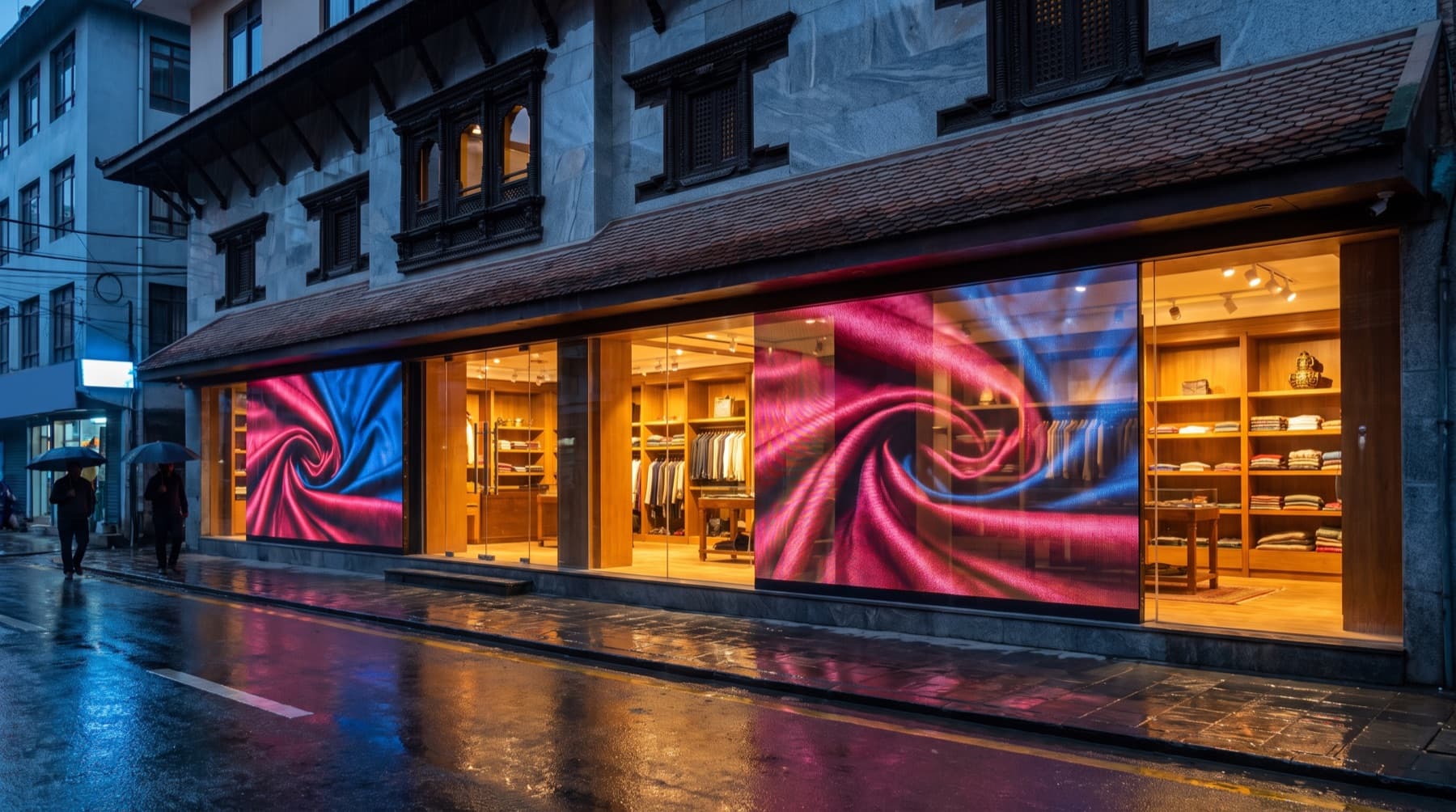
Digital signage is any screen that shows managed, scheduled content in a public or commercial space — a menu board, a bank queue display, a lobby welcome screen, a network of promotional screens across branches. In Nepal it is built from three parts: the display (usually a commercial LCD indoors, LED for large or outdoor faces), a media player, and a content management system that decides what plays where and when. Getting signage right is less about the screen and more about planning content, power and connectivity for local conditions.
What exactly counts as digital signage?
Digital signage is a screen, a player and a schedule working together, so that content changes without anyone walking up to the screen with a USB stick. A television on a wall showing a looped video is the most basic form; a proper system adds central control, scheduling and a record of what actually played.
The display can be a commercial LCD panel, an LCD video wall, a stretched bar display, an outdoor totem or an LED screen. The player can be built into the display, a small Android box, or a PC. The content system can be as simple as a local playlist or as capable as a cloud platform managing hundreds of screens across the country.
The useful distinction is between a screen that shows content and a system that manages it. Most disappointments come from buying the first while expecting the second.
Should signage in Nepal be LCD or LED?
Use LCD for indoor screens viewed from close range up to roughly two metres across, and LED for anything larger, seamless, or facing daylight. A commercial LCD gives a very sharp picture at short distance for a modest outlay, which is why it dominates menu boards, reception screens and queue displays.
LED takes over when the image must be bigger than a single panel without seams, when it is outdoors, or when it sits behind a sunlit shopfront window. An LED wall is built from modules, so it can be any size and shape, and outdoor LED reaches the 5,000 nits and above that daylight demands. Our guide to LED versus LCD video walls covers the crossover in detail.
Many projects use both: LCD screens at the counter and an LED screen on the facade, driven by the same content system.
Where does digital signage actually earn its place?
Signage pays off wherever information changes often or attention is short: restaurants, retail, banks and cooperatives, hospitals, schools, hotels and corporate lobbies. In each of these, the screen replaces repeated printing, gives staff a way to update messages in minutes, and puts the most relevant content in front of people at the right time of day.
In restaurants it is the menu board and daily specials. In banks, hospitals and government offices it is queue numbers, service information and notices. In retail it is promotions and new arrivals, and for multi-branch chains it is the ability to change every store’s screens from one office. We have deployed a networked retail signage system of this kind across multiple branches in Kathmandu, using scheduled playback managed centrally.
Where signage disappoints is when nobody owns the content. A screen showing last month’s offer does more harm than a blank wall, so decide who updates it before you decide which screen to buy.
How does content reach the screens?
Content reaches screens through a media player that stores a local copy and a CMS that sends updates whenever a connection is available. For Nepal, the single most important feature is offline playback: the player must keep running its schedule when the internet drops, and catch up when it returns.
Small installations can use the player built into a commercial display, loaded by USB or over the local network. Multi-site installations need a cloud CMS, with user accounts, scheduling, playlists per location and proof-of-play logs. LED screens are typically driven by NovaStar-type controllers and players, which also support cloud management. The choice between them is mostly a question of how many screens and sites you run.
Bandwidth matters more than people expect. Large video files pushed to many screens over a weak connection will fail; well-encoded content, staggered downloads and local caching keep a network reliable.
What do Nepal’s power and building conditions change?
Plan every signage installation for voltage swings, short outages and earthquake-safe mounting. Screens and players tolerate a stable supply well and an unstable one poorly; a stabiliser or online UPS on the signage circuit prevents the corrupted players and failed power supplies that account for many service calls.
Players should be configured to boot straight into content after a power cut, with no screen asking someone to press a button. Displays should be fixed to structural walls or properly engineered stands, not to partition boards, because a heavy panel on a weak fixing is a real hazard in a seismic zone.
Dust is the other local factor. Commercial displays pull air through their vents, so screens near busy roads or construction need periodic cleaning, and players hidden in closed cabinets need ventilation.
How should you plan a signage rollout?
Start with a pilot at one location, prove the content workflow, then scale. A pilot shows you how long content takes to produce, who approves it, how the screens behave on your network, and what your customers actually look at — all things that are expensive to discover across twenty sites at once.
Write down, before purchase, the number of screens and locations, viewing distances, whether any face daylight, who updates content, and whether you need reports of what played. Those answers decide the display type, the player, and whether a cloud CMS is worth it.
Check support terms as carefully as specifications. Our Evolve Signage LCD line carries a one-year warranty and our LED displays a two-year manufacturer warranty honoured locally, with spares held in Kathmandu. If you would like help scoping a network, we survey sites free of charge.
The short version
- Digital signage is a display, a media player and a content system working together, not just a screen.
- Commercial LCD suits close-range indoor screens; LED suits large, seamless, outdoor or window-facing faces.
- Offline playback is essential in Nepal so screens keep running when the internet drops.
- A stabiliser or UPS and auto-boot players prevent most signage service calls.
- Decide who owns and updates the content before choosing hardware.
- Pilot at one site, prove the workflow, then scale to more locations.
Common questions
What is digital signage used for in Nepal?
Digital signage in Nepal is used for restaurant menu boards, retail promotions, bank and hospital queue displays, school and office notices, and hotel and corporate lobby screens. Multi-branch businesses use it to update every location’s screens from one office.
Can I run digital signage without reliable internet?
Yes, provided the media player stores content locally and keeps playing its schedule offline. The CMS sends updates when a connection is available, so short or frequent internet outages do not leave the screens blank.
Is a normal TV good enough for digital signage?
A domestic TV can show a looped video, but it is not designed for long daily operation, often lacks a built-in player and remote management, and its warranty may not cover commercial use. Commercial displays are built for extended hours and managed playback.
Should I choose LCD or LED for a shop signage screen in Kathmandu?
Choose a commercial LCD for screens inside the shop viewed from close range, and LED for a large screen, a facade, or a screen behind a sunlit window. Window-facing screens need outdoor-level brightness to remain readable in daylight.
What warranty comes with digital signage screens?
Our Evolve Signage LCD displays carry a one-year warranty, and our LED displays carry a two-year manufacturer warranty honoured locally, with spares held in Kathmandu. Always confirm who services the product in Nepal before buying.
Where to go next
More in Digital Signage & LCD
Want this applied to your site?
We survey the site free, then spec the pitch, brightness and structure around what it actually needs.
Book a site survey