Guides / Outdoor & DOOH Advertising
Starting a DOOH advertising business in Nepal
8 min read · Updated October 2026
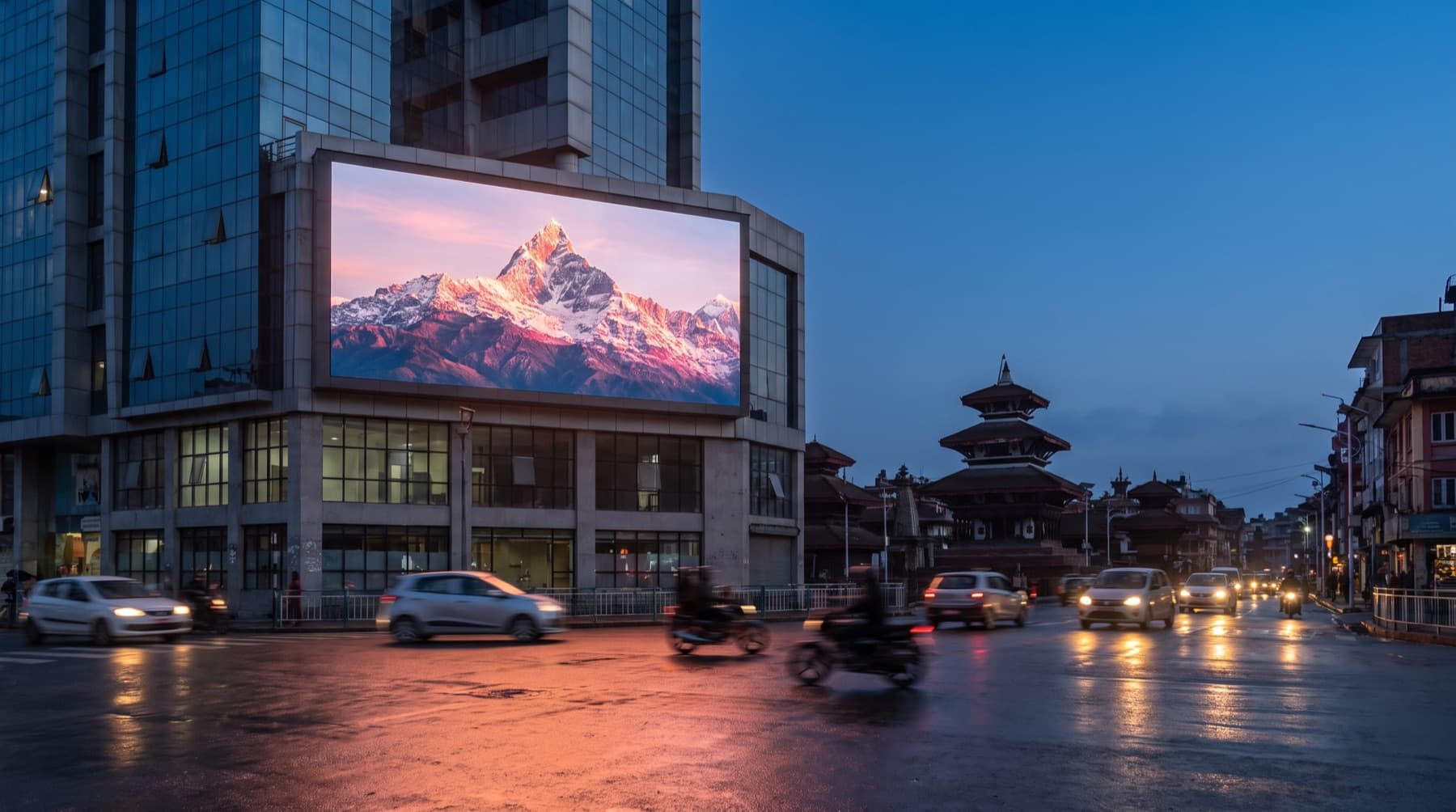
A DOOH (digital out-of-home) advertising business in Nepal is a media business, not a screen purchase: you secure a high-traffic site, install a weatherproof outdoor LED screen, and sell time on it to many advertisers in a rotating loop. The site decides your audience, the screen decides whether you can sell reliably for years, and your sales and scheduling discipline decide whether the loop fills. Get those three right, check permits with the municipality before you commit, and the same screen can carry many brands at once where a static board carries one.
What exactly is a DOOH advertising business?
A DOOH business owns or leases a visible outdoor location, operates a digital screen on it, and earns by selling short, repeating ad slots to multiple advertisers. Instead of renting one face to one brand for a month, you divide each loop of a few minutes into slots and sell each slot separately.
That changes the business model from property to media. Your customers are brands, agencies, banks, colleges, events and local shops, and what they buy is a share of attention at a known place, at known hours, for a known period. Your job is to keep the screen bright, on and fed with correctly scheduled content, and to prove to advertisers that their creative ran.
In Nepal, several operators already run this model on busy roads and junctions — for example LED Matrix on a highway-facing screen at Nagdhunga, Universal Advertising at Lakhan Thapa Chowk in Butwal, and STR Advertising with a large curved building wrap in Kathmandu. Their sites differ, but the fundamentals are the same.
Why does the site matter more than the screen?
The site is the product you are selling, so it should be secured and evaluated before any screen is specified. Advertisers pay for the people who will see the message — how many pass, how slowly, how often, and who they are — and no screen specification can rescue a location nobody looks at.
Good DOOH sites in Nepal share a few traits: traffic that slows or stops (junctions, signals, bus stops, the approach to a bridge), a clear line of sight from a reasonable distance, a face oriented towards the dominant flow, and a structure or roof you can legally and safely build on. A site on the Ring Road approach where vehicles queue is worth far more than a faster stretch with a better view.
Lease terms matter as much as footfall. A screen is a multi-year asset, so negotiate a lease long enough to recover the investment, with clear rights to power, access for maintenance and the structure itself. Our guide to choosing a billboard location goes deeper on judging a location.
What screen specification does a DOOH operator need?
A DOOH screen needs a pitch matched to viewing distance, outdoor brightness of around 5,000–8,000 nits, IP65 sealing on both front and rear, and an engineered steel structure. Pixel pitch in millimetres roughly equals the closest comfortable viewing distance in metres, so roadside billboards typically use P6–P10 rather than a fine indoor pitch.
Durability is the commercial specification, not an engineering nicety. Every hour the screen is dark is an hour of inventory you cannot sell and a make-good you owe. That means front-and-rear sealing for the monsoon, stable power with surge protection, components rated for heat and dust, and spare modules held locally so a failed module is a visit, not a shipment.
Choose the control system with the business in mind. A cloud CMS that lets you schedule loops remotely, see that the screen is online and pull playback logs is what lets you run a network of screens from one office and show advertisers proof of play.
Which permits and approvals should you check?
Outdoor advertising permission in Nepal is set locally, so the first step is to ask the relevant municipality and ward office what they require for your specific site before signing anything. Requirements vary between municipalities and change over time, and roads under different authorities may have their own conditions.
Expect questions about the structure’s safety, the size and position of the screen, brightness and its effect on drivers, and the landlord’s consent. Keep your structural drawings, the landlord agreement and the equipment documentation ready, and get any approval in writing.
Treat approval as a dependency on the project timeline, not an afterthought. A screen installed on a site that later fails approval is the most expensive mistake in this business.
How do DOOH operators make money from the screen?
Revenue comes from selling slots in a repeating loop, so income depends on how many slots you sell, for how long, and at what occupancy. A typical structure is a loop of a few minutes split into slots of 10–15 seconds, sold by the week or month, with premium positions or exclusive takeovers sold separately.
Occupancy is the number that matters most. A screen that is half sold earns half, regardless of how impressive it looks, so most operators start with a sales pipeline of local advertisers — banks, colleges, telecoms, real estate, events and festival campaigns around Dashain and Tihar — before the screen is even lit.
We do not publish figures or promise returns; earnings depend entirely on the site, the market and your sales effort. Our guide to LED display return on investment explains how to model it honestly.
What does it take to run a DOOH screen day to day?
Running a DOOH screen is mostly operations: scheduling content, checking that the screen is on and correct, maintaining it, and reporting to advertisers. A screen that drifts out of brightness, shows a dead module or plays last week’s campaign loses advertisers quietly.
Set up a routine from day one: remote monitoring of on/off status and temperature, a daily check of the loop, scheduled night dimming, regular cleaning of dust from the face and vents, and a maintenance visit before and after the monsoon. Keep an annual maintenance contract or in-house technician who knows the screen.
Plan for power. Voltage swings and load management are part of life in Nepal, so a protected, stable supply and a plan for outages protect both the hardware and your inventory.
How should a new operator get started?
Start with one excellent site rather than several average ones, prove occupancy, and expand from there. A single well-run screen teaches you sales, scheduling and maintenance before you commit to a network.
Bring us the site, the viewing distance and the hours you plan to run, and we will survey it free, specify the screen and structure, and give you a quotation for a complete installed system. Pricing questions are covered in our LED display price guide.
The short version
- A DOOH business sells rotating ad slots to many advertisers on one outdoor screen.
- The site is the product: secure and evaluate it before specifying any screen.
- Outdoor DOOH screens need around 5,000–8,000 nits and IP65 sealing on front and rear.
- Outdoor advertising permission is set locally — check with the municipality and ward before committing.
- Occupancy, not screen size, decides how much a DOOH screen earns.
- Remote monitoring and proof of play are what let you keep advertisers.
Common questions
How do I start a digital billboard business in Nepal?
Start by securing a high-traffic site with a long enough lease, then confirm with the municipality and ward office what approvals the site needs. Once the site is viable, specify an outdoor LED screen with suitable pitch, brightness and IP65 front-and-rear sealing, and build a pipeline of advertisers before the screen goes live.
What size LED screen is best for a DOOH billboard?
The right size depends on viewing distance and the structure the site can carry. Roadside billboards commonly use pitches of P6–P10 and sizes chosen so text is legible from the main approach. A site survey decides the practical maximum, because structure and wind load limit size as much as budget does.
Do I need permission to put up an LED billboard in Nepal?
Yes, outdoor advertising is regulated locally, and requirements vary by municipality and change over time. Check with the relevant municipality and ward office for your specific site before signing a lease or ordering equipment, and get any approval in writing.
How do DOOH operators prove to advertisers that their ads ran?
Most use a cloud content management system that records playback logs showing when each creative played. Combined with dated photographs or video of the screen, these logs give advertisers proof of play and support make-goods if the screen was ever off.
How long does an outdoor LED billboard last?
A well-specified outdoor LED screen that is properly sealed, powered and maintained typically runs for many years. Lifespan is shortened mainly by poor sealing, unstable power, overheating and skipped maintenance, which is why specification and an operating routine matter as much as the purchase.
Which brands do DOOH operators in Nepal use?
Operators in Nepal run screens from lines including Lampro and Unilumin, which are sister brands in the same group, as well as our own Evolve range. The brand matters less than correct specification for the site, local spares and a warranty honoured in Nepal.
Where to go next
More in Outdoor & DOOH Advertising
Want this applied to your site?
We survey the site free, then spec the pitch, brightness and structure around what it actually needs.
Book a site survey